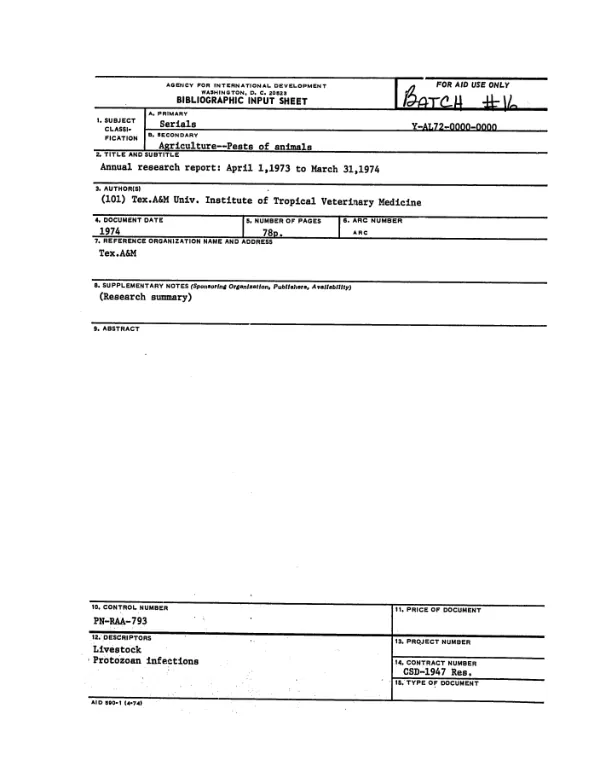
TEXAS A & M UNIVERSITY (TAMU). INSTITUTE OF TROPICAL VETERINARY MEDICINE
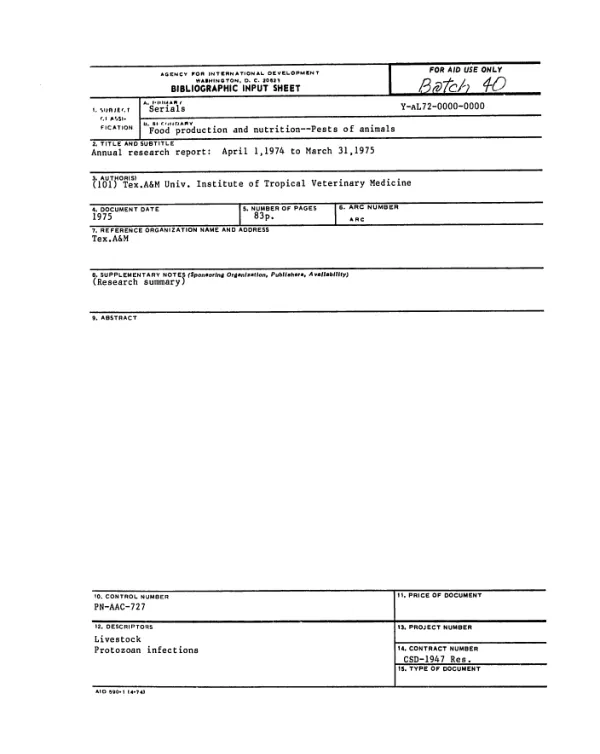
Annual research report, 1974/1975
The Institute of Tropical Veterinary Medicine was established at Texas A&M in 1967.
1970
Sign in to readA free account is required to download.
Abstract
Its research program on control of hemotropic diseases in cattle in the tropics was begun that year at Bogota, Colombia, as a cooperative effort with the Instituto Colombiano Agropecuiario (ICA). With support by AID and the Rockefeller Foundation, research and graduate training programs were conducted from 1968 to 1975 in both Texas and Cali, Colombia. The purpose of the research was to develop means of protecting cattle against blood infestations by such parasitic organisms as Anaplasma and Babesia. These infections, which are similar to malaria in humans, are transmitted by ticks and flies. Their effect on cattle and other domestic livestock is to limit growth and weight gain, and, in severe infections, cause early death of the infected animals. While no final solution for Anaplasma and Babesia was found, significant progress was made in developing means of reducing cattle losses and increasing the productivity of cattle in such highly endemic areas as the north coast of Colombia, where about 80% of the cattle are infected. Controlled field studies using premunition or vaccination to prevent losses have been successful. Vaccinated cattle, as a group, gained almost three times as much weight over a ten-month period as did unvaccinated cattle. Chemotherapeutic studies yielded variable success. Anaplasma infections can be eliminated temporarily with two injections of the drug Imidocarb (5 mg/kg), but this level of medication was found to be dangerously near the toxic level. Moreover, one year after treatment, the incidence of infection was essentially as high as seen originally. In contrast, the use of as little as 1 mg/kg of Imidocarb against Babesia consistently eliminated it from infected cattle. In research on diagnostic techniques, useful serologic methods were developed, using complement-fixation, a rapid card agglutination test, and an indirect fluorescent antibody test. These tests have been used in identifying Babesia infections in Haiti, the Mariana Islands, Nicaragua, Mexico, and Texas.
Related documents