USAID DEC
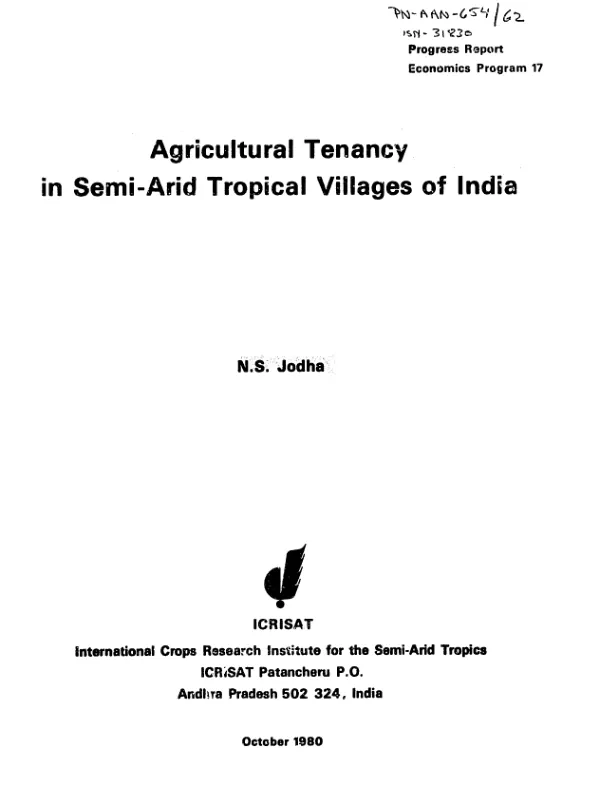
Approach and hypotheses for the village level studies of the international crops research institute for the semi-arid tropics
Sign inINTERNATIONAL CROPS RESEARCH INSTITUTE FOR THE SEMI-ARID TROPICS (ICRISAT)
Approach and hypotheses for the village level studies of the international crops research institute for the semi-arid tropics
This report contains anthropological and economic discussions of conditions for the promotion and maintenance of group action among farmers whose improved use of agricultural resources depends upon collective measures.
Binswanger, Hans P.; Jodha, N. S. · 1970
Sign in to readA free account is required to download.
Abstract
The purpose is to demonstrate principles of social organization which help promote the increased welfare of agricultural communities by coordinating and improving use of the natural resources exploited by their members. Disregard of the long-term ecological consequences of traditional farming systems is a principal reason for instability and stagnation of agriculture in semi-arid tropical regions. Coordination or group action are necessary since many agricultural development problems affect not only individual holdings but also larger environmental units. Cases are compared from different areas of India. Topics included are (1) the need for watershed-based systems of farming; (2) implications of the fragmentation of watersheds; (3) conditions for group action; (4) group action for credit and marketing; (5) group action for local irrigation control; and (6) group action for irrigation development and for land shaping. The main conclusion is that in the absence of expensive, centralized administrative control, local group action can only be based on rules which establish a society of reciprocity rather than redistribution with respect to the resource or activity involved. Willing participation can only arise if the resource in question works in the same way for all its users and if each has the right and opportunity to protect his interests.