USAID. BUR. FOR ASIA AND NEAR EAST
ARRSTC completion report
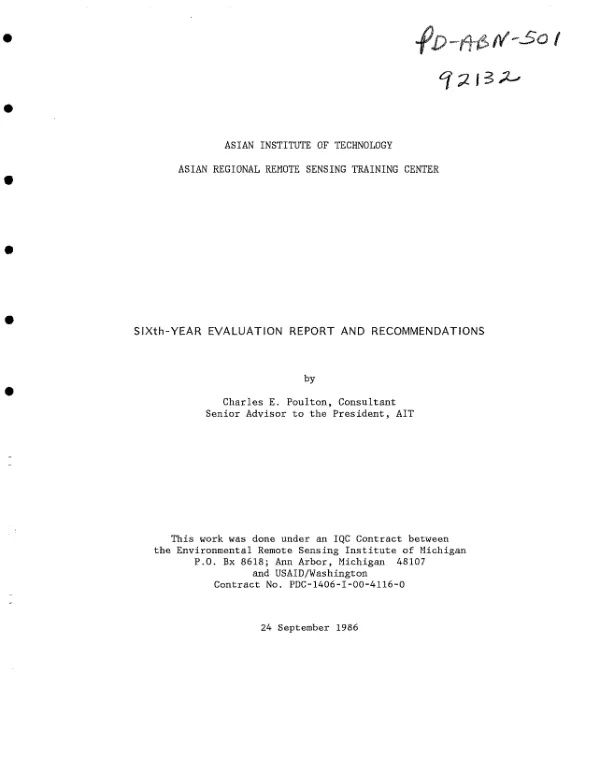
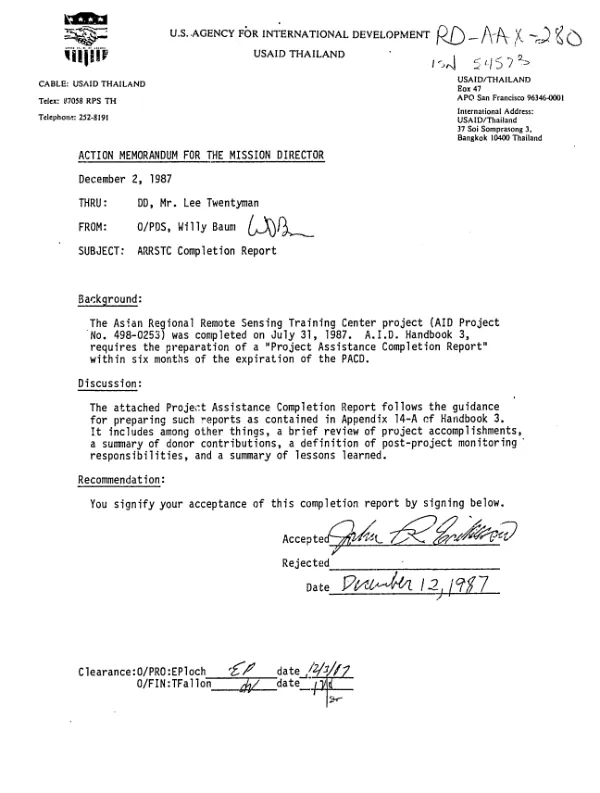
Project Assistance Completion Report on a project (1980-87) to establish the Asia Regional Remote Sensing Training Center (ARRSTC) in Thailand.
Baum, Willy · 1987
Sign in to readA free account is required to download.
Abstract
The project succeeded in creating a regional facility for training scientists in the analysis of remotely sensed data. The center includes a variety of digital systems for data analysis, including a mainframe-based DIMAPS system, a superminicomputer-based ATLAS system, and microcomputer-based ERDAS and Pericolor systems. The supermini system is also capable of processing data from French SPOT satellites. ARRSTC's analog data analysis system includes a photographic laboratory with sophisticated processing equipment and the capability of converting analog data to digital (and vice versa). About 300 scientists from 18 participating regional countries have received training on this equipment, and some also received advanced training in geographic information systems. Initial efforts were also made under the project to establish a regional databank of remotely sensed data; while still small in size, the data bank has the potential to become a major resource in future remote sensing research programs. Long-term sustainability of the ARRSTC is threatened by less than expected financial contributions from participating regional countries. In some cases, individual countries have established their own competing remote sensing facilities, even though the ARRSTC is recognized as the premier facility of its kind in Asia. This, coupled with a shift in professional attitudes away from remote sensing as an end in itself and towards its usefulness as a tool for natural resource inventorying, caused the ARRSTC to not be utilized to the extent originally planned. One lesson that can learned from this is the importance of providing for the long-term viability of the project from the design stage on, and the need for a continuing financial commitment from A.I.D. to ensure this viability. When ARRSTC's parent organization, the Asia Institute of Technology, responding to a mid-term evaluation recommendation, moved to integrate the ARRSTC with its Interdisciplinary Natural Resources Development and Management program (INDRM), the Asia Bureau was unable to respond to a request for an additional $350,000 for the INDRM program. While A.I.D. cannot be expected to fund projects indefinitely, clearly modest requests for funding that can help ensure project sustainability should be met.
Related documents