USAID DEC
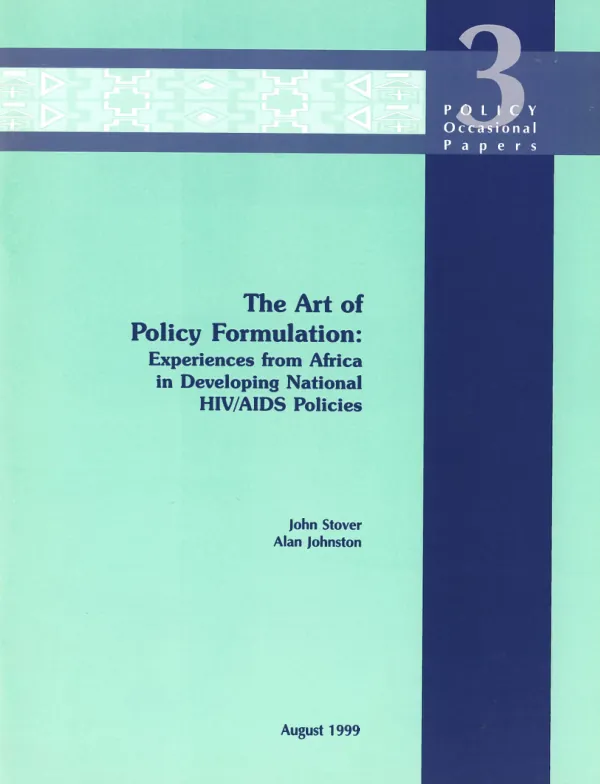
Art of policy formulation : experiences from Africa in developing national HIV/AIDS policies
Sign inCENTRE FOR DEVELOPMENT AND POPULATION ACTIVITIES (CEDPA)
Art of policy formulation : experiences from Africa in developing national HIV/AIDS policies
This report presents case studies of the experience of nine Anglophone African countries -- Ethiopia, Ghana, Kenya, Malawi, South Africa, Tanzania, Uganda, Zambia, and Zimbabwe -- in developing and implementing national HIV/AIDS policies.
Stover, John; Johnston, Alan · 1999
Sign in to readA free account is required to download.
Abstract
Key elements of the policymaking process discussed include problem identification and need recognition, information collection, drafting, review, approval, and implementation. Despite cultural, social, and legal differences among the study countries, positions on key issues show many similarities. Topics that proved the most difficult to resolve included: (1) Should the government subsidize voluntary counseling and testing programs? (2) Should employers be allowed to conduct pre-employment testing, which generally violate rights to gain livelihood without discrimination? (3) Should special programs be targeted to help AIDS orphans stay in school and receive proper food, clothing, and care, or will such programs increase stigmatization? Should AIDS orphans receive benefits not available to other orphans? (4) To what extent should the formal education system teach children about HIV and ways to protect themselves? (5) Should advertising of condoms be permitted through mass media? (6) Can the government require the use of condoms in commercial sex when the latter is illegal? (7) Should the government distribute condoms in prisons if homosexual behavior is deemed illegal? (8) Should willful transmission be criminalized, or would criminalization discourage people from seeking testing? (9) Should HIV infection be considered a sufficient cause for abortion? When consensus on an issue, e.g., willful transmission of HIV, was difficult, the issue was either eliminated from consideration or left open to interpretation through implementation guidelines. Key lessons learned from the case studies are as follows: (1) Recognition of the need for a comprehensive AIDS policy may become apparent only when the epidemic becomes so severe that a large portion of the population is affected or when the advocacy efforts of specific groups convince decisionmakers of the importance of a policy response. (2) Highly participatory approaches may require less time for policy development than policies drafted rapidly by a small group of experts who then struggle for years to gain approval. The most participatory processes have produced the broadest policies covering a wide range of key issues. (3) Approved policies can be implemented in many ways. Some aspects (such as approval of condom advertising) may be implemented directly, in some cases even before the policy is formally approved. Other issues can be implemented only through enabling legislation, guidelines, or a strategic plan. Countries may lack the resources to implement all facets of a policy at once. Interest groups may need to take the lead in advocating for the implementation of specific portions of the policy.
Related documents
![HIV/AIDS SS04 [strategic support objective] annual report, October 1, 2000-September 30, 2001](https://covers.devme.ai/gen/82404.webp)