PARTNERS FOR GLOBAL RESEARCH AND DEVELOPMENT, LLC (PGRD)
Assessment of capacity development in selected USAID/Peru activities
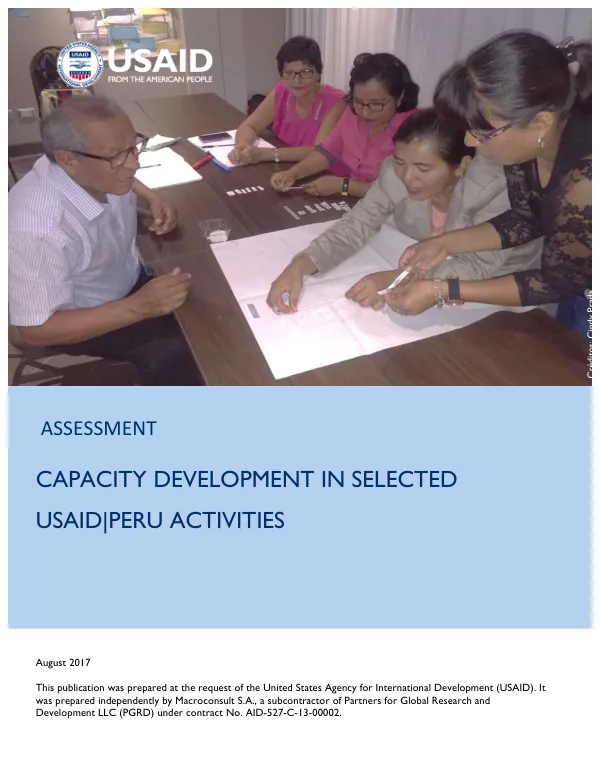
This report presents the Capacity Development (CD) experiences of seven of USAID’s activities in Peru, using the Human and Institutional Capacity Development Model (USAID, 2010) to address CD at both institutional and individual levels.
Soltau, Luis; Espinosa, Diego +4 more · 2017
Sign in to readA free account is required to download.
Abstract
The analysis of four elements —the CD conceptual model, methodology, implementation and overall results— was based on a comprehensive review of activity reports related to the seven cases and information gathered during interviews with selected informants, counterparts and beneficiaries. The cases show the particularity and complexity of the design, implementation and follow-up of CD interventions. Lessons learned from the analysis of the cases include: Better capacity development results are obtained when the model integrates individual needs with those of the organization and the environment. Likewise, capacity development is enhanced when strategies are based on a previous analysis of the organization"s context, needs and capacities, and when the design is developed in a participatory manner, considering the characteristics and interests of the organization and the intervention site. In the case of the public sector, capacity development interventions included in the institution"s operational plan are more likely to be financed and therefore sustainable. On the other hand, faced with the challenge of frequent turnover of managers and workers, organization-wide communication is important to ensure the continuity of the improvements achieved. Finally, adding specific capacity development indicators at the process, results and outcome levels facilitates the monitoring and understanding of capacity development at the individual and institutional levels.
![[Peru] evaluations activity final progress report, contract number: AID-527-C-13-00002, April 1, 2013 - March 31, 2018](https://covers.devme.ai/gen/94444.webp)