COMMUNITY SYSTEMS FOUNDATION
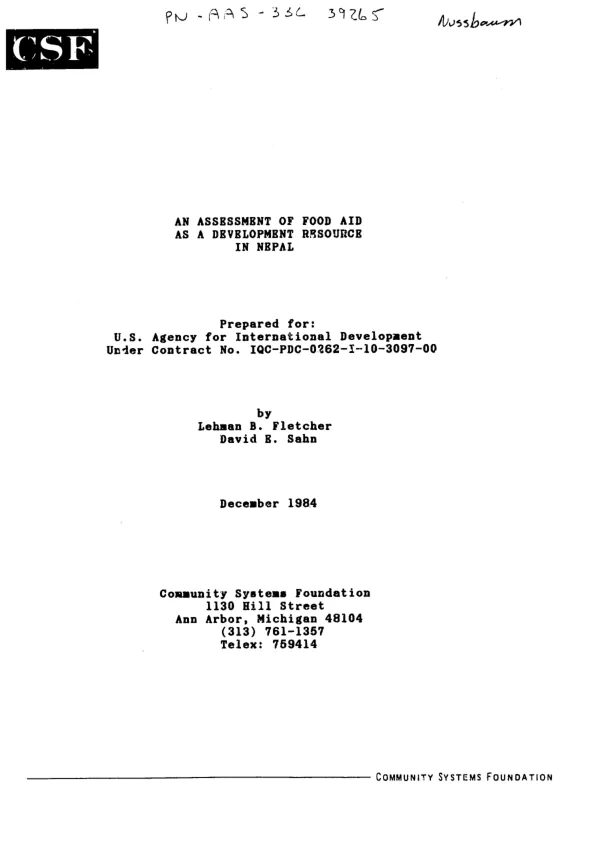
Assessment of food aid as a development resource in Nepal
The appropriateness of donor food aid programs given the Government of Nepal"s (HMG) current development strategy and related policies is assessed.
Fletcher, Lehman B.; Sahn, David E. · 1984
Sign in to readA free account is required to download.
Abstract
The report first reviews trends in food production and availability and the extent of food deficits, and examines HMG policies regarding food distribution, price supports, food security, and trade policy. The second part of the report assesses the role and limitations of current and projected food aid programs in terms of cost-effectiveness, choice and local purchase of food commodities, size of ration, monetization, local costs, and food stabilization policies. Emphasis is placed on the pros and cons of using Food for Work to increase agricultural production. Eighteen statistical tables document this assessment. On the basis of these analyses, the authors recommend against a bilateral P.L. 480 program due to the bias against farmers of current HMG policies, the HMG"s limited absorptive capacity, the difficulties of administering such a program, and the possibility that the program would replicate current efforts of the World Food Programme (WFP). Instead, 19 specific recommendations are made for exploring joint WFP-USAID efforts and helping the HMG improve its development policies.
Connected topics
Related documents