CARANA CORP.
Assessment of mobilizing the Guyanese expatriate community
Many developing nations in Latin America and the Caribbean have an undertapped development resource: their expatriate communities in the United States.
1996
Sign in to readA free account is required to download.
Abstract
This study examines the feasibility of mobilizing financial and human resources from the expatriate community in the United States to invest in Guyana. According to the report, expatriate Guyanese are willing to invest in their native country, although more in terms of human capital than financial capital. Many already have financial investments in Guyana, donate money and goods for humanitarian and social purposes, and make periodic visits. The organizational network in the United States, while not well-developed formally, covers a large area though word-of-mouth and media communications and could play an important role in mobilizing capital and skilled human resources. Although the embassy and consulate lack initiatives in structured investment promotion, they could disseminate investment-related information and help to coordinate activities for the repatriation of financial and human capital. The capital repatriation that already exists is unorganized and not channeled toward sectors key to economic growth and development. No organized repatriation of human resources exists, although the desire to help Guyana is strong. Developing a USAID project to repatriate finances and human resources is a risk, but the payoff could be substantial. The best options for implementing a financial and human resource repatriation project are to (1) develop a community-based private voluntary organization, with a board and staff comprised of members of Guyana"s major ethnic and religious groups (this option would require more up-front investment, but the payoff could justify the expense); or (2) work through an existing and broadly representative institution in Guyana, e.g., the Private Sector Commission or the Consultative Association of Guyanese Industries. Regardless of the implementing organization chosen, any initiative will need to work with Guyanese policy makers to help create an effective investment incentive system. A model finance and human resources repatriation project is sketched in conclusion. Includes bibliography and over 20 pages of Guyanese professional and business contacts in the United States. (Author abstract, modified)
Related documents
Documents in this collection
 2001
2001USAID DEC
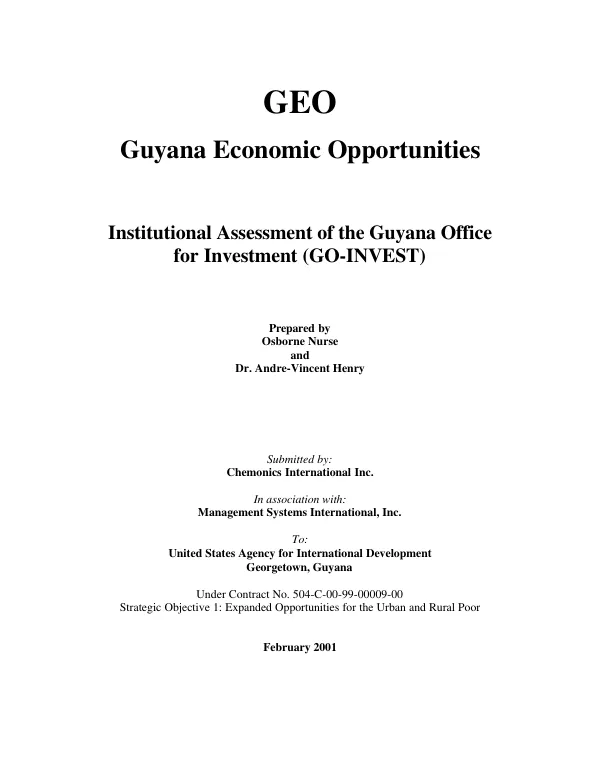
GEO Guyana economic opportunities : institutional assessment of the Guyana Office for Investment (GO-INVEST)
Open record![Rapid appraisal : trade policy, macro economic policy, information technology, private sector organizations, investment and export promotion, [and] microcredit/micro-enterprise development](https://covers.devme.ai/gen/32333.webp) 1999
1999USAID DEC
![Assessment of the readiness of the Guyana information youth project [GIYP] to institute a micro-lending component](https://covers.devme.ai/gen/35922.webp)