USAID DEC
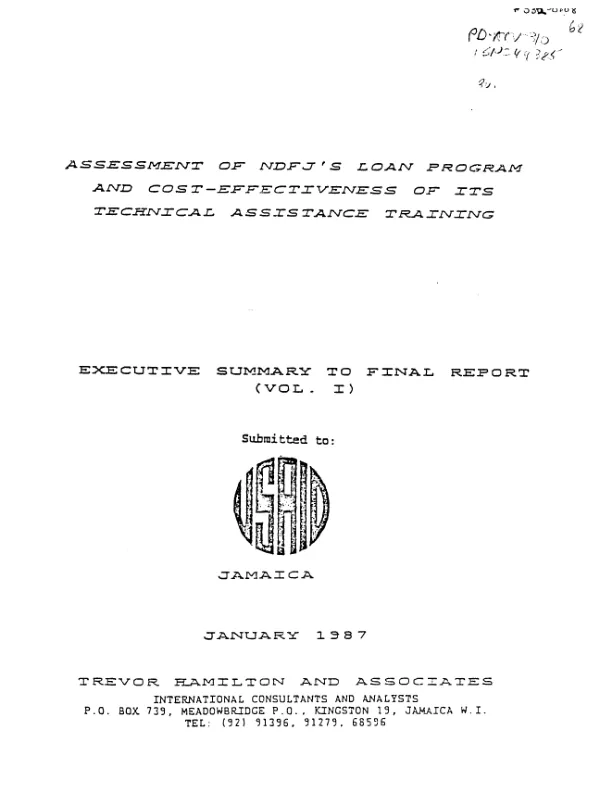
Assessment of NDFJ's loan program and cost-effectiveness of its technical assistance training
Sign inTREVOR HAMILTON AND ASSOCIATES
Assessment of NDFJ's loan program and cost-effectiveness of its technical assistance training
Evaluates the National Development Foundation of Jamaica's (NDFJ) program of credit and technical assistance/training (TAT) for small businesses.
1986
Sign in to readA free account is required to download.
Abstract
External evaluation covers the period 1982-3/87 and is based on document review, and visits and interviews with 270 loan clients. NDFJ has delivered 1,202 loans (mostly in the manufacturing and services sectors) totalling $9 million. Annual growth in the number of loans averaged 50% in 1983-83 but fell to 9% in 1986 due to inflation and currency devaluation and to a severe shortage of field officers and vehicles for servicing loans and processing applications. About 74% of loan-financed enterprises are growing impressively, due to adequate financing, TAT follow-ups, and a favorable environment (13% are closing, citing a lack of these factors). Average sales for businesses have increased from $42,000 to $70,000, gross profits from $16,000 to $32,800, and relative profitability from 38% to 47%. Some 90% of client businessowners now depend on their businesses as their sole source of income and 72% (up from 51%) work 40 hours or more each week. Total employment is 4,278, vs. 2,507 prior to the loans; women have especially benefited, since both garmentmakers and the service sector (heavily represented among clients) traditionally employ women and since women represent a larger pool of available labor. The bias in loans, however, is toward males, who own a greater share of established businesses, which are favored by NDFJ to reduce risk. TAT was provided to over 10,000 clients and was particularly useful since few had ever received business training. Group training has exceeded target because of its low cost, but follow-up TAT to loan clients has been undersupplied by 32%, due to NDFJ's vehicle and personnel shortages. Although frequency of follow-up visits has been strongly correlated with clients' success, 50% or fewer receive the minimum monthly visit. TAT should focus more on growth and competitiveness rather than accountability, and field officers need more business training. Far too much TAT was provided to non-loan recipients; there is no system to follow up on these clients. NDFJ's portfolio is low-risk: 34% has been fully repaid, and only 2% is considered bad debt (although 15% is in arrears). However, the loan/TAT program has not been able to meet self-financing targets or to satisfy demand (which exceeds loan supply by $5 million). Further, administrative costs have run over 40% and cannot be reduced until NDFJ increases its portfolio fivefold. Key recommendations are that loan recovery periods be rationalized (reduced to 6-30 months) and TAT self-financing potential exploited (only 27% of clients can pay for TAT at receipt, but 80% would be able to pay within a 4-year period).
![New economy project [NEP] : final evaluation report USAID/Jamaica](https://covers.devme.ai/gen/35713.webp)
![New economy project [NEP] : final evaluation report USAID/Jamaica](https://covers.devme.ai/gen/5281.webp)