UNITED NATIONS CHILDREN'S FUND (UNICEF)
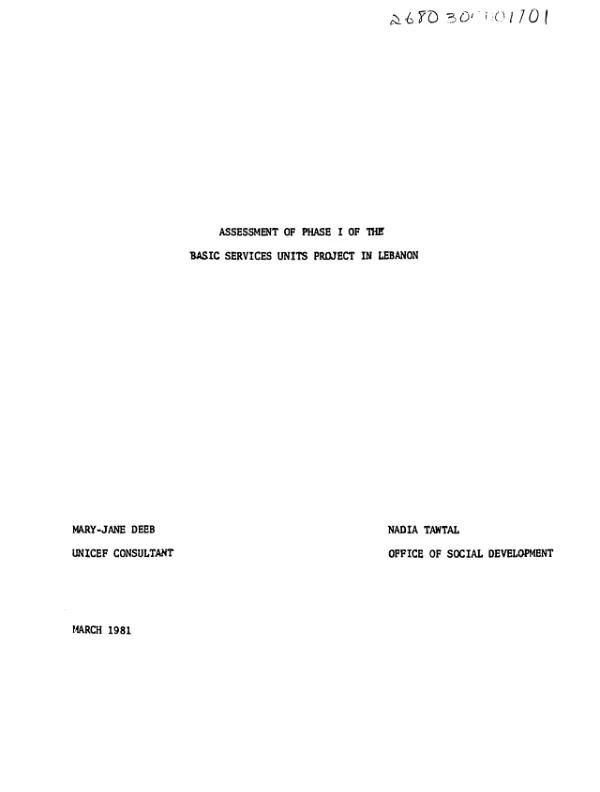
ASSESSMENT OF PHASE I OF THE BASIC SERVICES UNITS PROJECT IN LEBANON
Evaluates project to assist UNICEF in establishing nine community basic services units (BSU) in Lebanon.
DEEB, MARY J.|TAWTAL, NADIA · 1981
Sign in to readA free account is required to download.
Abstract
Special evaluation is attached to a PES facesheet (PD-AAH-415-A1), covers the period 9/79-3/81, and is based on site visits. Progress has varied widely. All nine BSU's have rented facilities, hired various personnel, and received equipment. However, no single BSU is completely staffed; trained personnel are scarce, especially in rural areas; and the units are too dependent on central administrators. Ordering appropriate equipment and ensuring its proper delivery, storage, and use have been problematic. Only the model unit established in Bourj-al-Brajneh in 1971 is delivering a full range of services. Seven BSU's are delivering some services -- six provide health care, two have day care, and five offer community extension services (mainly literacy classes and sewing programs). There is a dearth of information at all levels. The Government of Lebanon is unclear as to UNICEF's role as equipment agent, program planner, and decisionmaker. BSU's lack adequate knowledge of the communities they serve and are hesitant to initiate programs or tailor services to local needs. Finally, the communities in which the units are located are often unaware of the services available. Included in the recommendations are: (1) upgrade existing BSU's and establish no new units in 1981; (2) each unit survey local needs and resources and prepare short- and long-term programs; (3) deliver no more equipment until after the community is surveyed, delivered equipment is accounted for, and more BSU's are established; (4) explicitly define UNICEF's role and improve communication between all levels; (5) promote BSU's in the mass media; (6) foster initiative at the unit level; (7) gear the program to better serve rural needs, including recruitment of more personnel from rurla areas; (8) survey available Lebanese training resources; (9) give priority to hiring unit supervisors; (10) improve the curriculum and curtail pre-service training for auxiliary personnel; and (11) improve the operation and monitoring of in-service training.