TVT ASSOCIATES
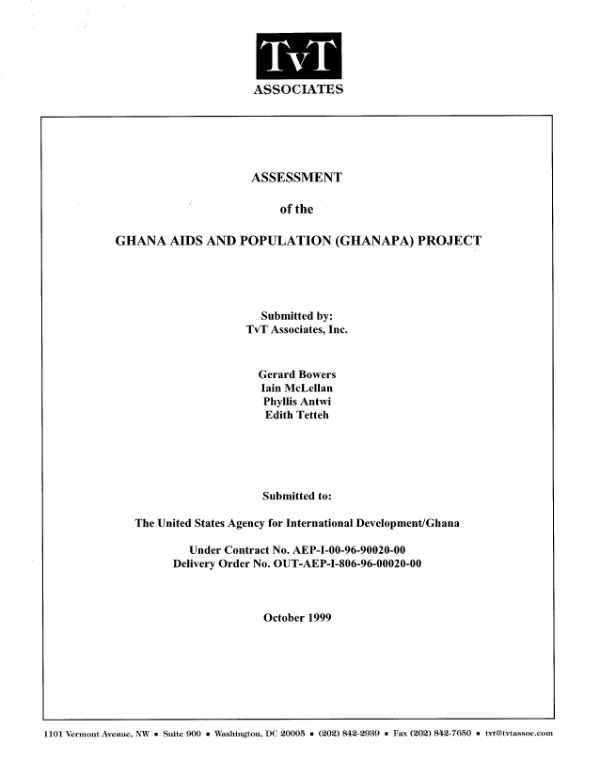
Assessment of the Ghana AIDS and population (GHANAPA) project
Evaluates program/project to increase the use of modern family planning (FP) methods and help stabilize the HIV/AIDS epidemic in Ghana (GHANAPA project).
Bowers, Gerard|McLellan, Iain · 1999
Sign in to readA free account is required to download.
Abstract
Interim evaluation covers the period 9/94-10/99; it does not assess a child survival component added in 1998. GHANAPA has produced some significant accomplishments, though some fell short of expectations. (1) Ghana's modern contraceptive prevalence rate (CPR) is over 13%, which, while well short of the project's 20% target, is relatively high for sub-Saharan Africa. (2) Ghana's policy and regulatory environment for population and FP is very positive. However, while a national policy on AIDS will be released in the very near future, few public leaders or prominent figures have expressed support for a more vigorous Government of Ghana (GOG) response to the threat posed by HIV. Long-term FP methods are not yet a significant factor in Ghana's FP/reproductive health (RH) program, due to cultural biases, client fears and misperceptions, and the lack of meaningful information, education and communication (IEC) support. Two clinical methods, injectables and Norplant, however, show strong promise for the future. (3) Ghana's contraceptive management system is orderly, efficient, and effective. Oral contraceptives and condoms are being marketed at affordable prices by the Ghana Social Marketing Foundation through more than 3,000 outlets. The lessons of a USAID-supported operations research project (Navrongo) have been embraced by the leadership of the Ministry of Health (MOH) as a model for community-based FP/RH programs. (4) Protocols and guidelines developed for health care providers have the potential to standardize and improve service delivery at all levels of the health care system. Dissemination of the guidelines is proceeding very slowly, however. (5) Ghana's total fertility rate (TFR) of 4.6 exceeds the 5.0 GHANAPA target. Even though this figure is not wholly due to the project, it could not have been attained without it. (6) Public awareness of HIV/AIDS is high, but has not yet been translated into the necessary level of behavior change, and GOG health education efforts have been inadequate. (7) The GOG's HIV sentinel surveillance system is in place, and can serve as an accurate early warning system for any upsurge in HIV prevalence. Current national prevalence, as measured by this system, is approximately 4%. An increasing number of health care practitioners in the public and private sectors have adopted STD-management protocols developed under the project. The project's shortcomings can be attributed in good part to overly ambitious targets, e.g., the expectation that the use of long-term methods and the overall CPR would double in 6 years. The unmet need for RH services remains high in Ghana, such that a continuing, well-executed assistance program can be expected to produce a steady, if not especially dramatic, increase in prevalence in the years ahead. The project was also constrained by inadequate GOG support for its own RH program -- support that was expected as a consequence of USAID's nonproject assistance (NPA) agreement with the GOG. (In fairness to the GOG, USAID/Ghana terminated NPA abruptly in 1997 without prior consultation with the GOG; some resources which the latter had anticipated under the NPA were never provided.) For the future, USAID's assistance program in FP/RH should concentrate on ensuring that all sexually active Ghanaians have access to at least three and preferably four FP methods -- including, at a minimum, pills and condoms. Special attention should be given to training and service extension efforts, which will expand the availability of injectables and Norplant. USAID, in partnership with the POLICY project and the GOG, should reorient its policy and advocacy investments to focus on increasing public awareness of the threat posed by HIV/AIDS and measures the public can take to avoid infection. This initiative should be concentrated on communicating with young adults and adolescents, and should include specific information they need to prevent unwanted pregnancy and to avoid transmission of STDs and HIV, as well as, importantly, strengthened public and private sector efforts to ensure that young adults and youth have improved access to FP/RH services. USAID support for expanding the Navrongo pilot project should avoid cost-and-capital- intensive items that might complicate the wide-scale replicability of the model.