USAID DEC
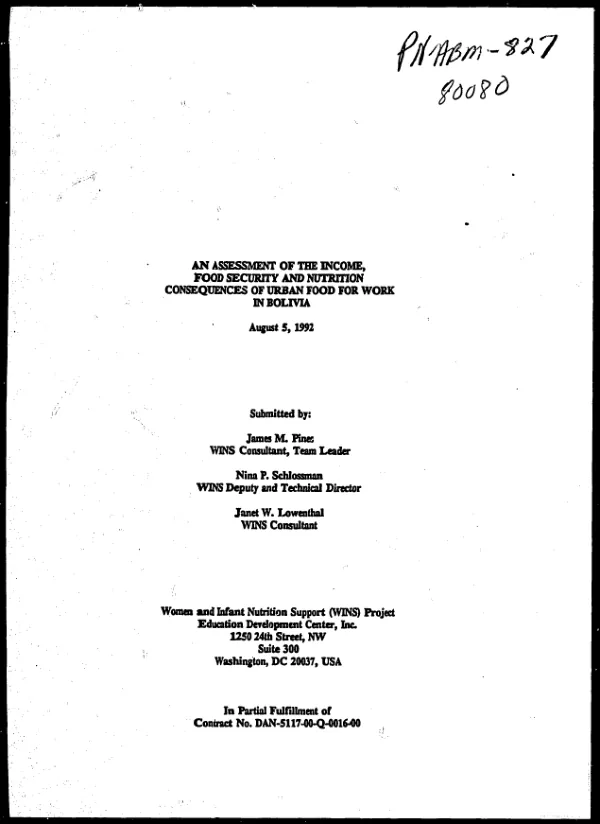
Assessment of the income, food security and nutrition consequences of urban food for work in Bolivia
Sign inEDUCATION DEVELOPMENT CENTER, INC. (EDC)
Assessment of the income, food security and nutrition consequences of urban food for work in Bolivia
USAID/Bolivia"s Urban Food for Work Program (UFFW) has intentionally focused, with great success, on creating employment and infrastructure, not on nutrition or food security.
Pines, James M.; Schlossman, Nina P. +1 more · 1992
Sign in to readA free account is required to download.
Abstract
However, recent U.S. legislation mandating that all P.L. 480 food aid help achieve food security makes it important to re-assess the Bolivian program. UFFW in Bolivia comprises three projects, in El Alto, Cochabamba, and Santa Cruz de la Sierra, which differ in regard to size, target population, level and type of compensation, and project design. While the projects have very different consequences for nutrition, food security, and income, in general the Bolivian program makes positive contributions to community and national food security both directly, by increasing access to food, and indirectly, through improved infrastructure. The study clearly demonstrates, however, that food security impacts can be enhanced (without compromising infrastructure impacts or raising costs) by paying food wages primarily to women, and increasing the wages enough, by some combination of increased productivity and reduction of tasks, to assure a significant net addition to family food availability. The study also suggests that whenever possible UFFW participants should work on small projects within their own communities.
Connected topics