USAID DEC
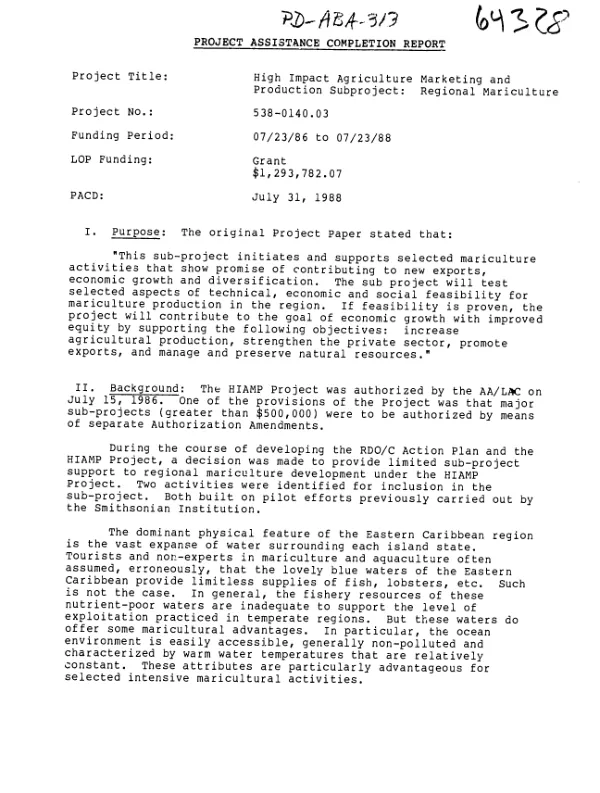
Assessment of the status of the system developed by the marine systems laboratory of the Smithsonian Institute for raising the Caribbean king crab by mariculture
Sign inUSAID. BUR. FOR LATIN AMERICA AND THE CARIBBEAN. REGIONAL OFC. FOR CENTRAL AMERICAN PROGRAMS (ROCAP)
Assessment of the status of the system developed by the marine systems laboratory of the Smithsonian Institute for raising the Caribbean king crab by mariculture
Evaluates contract with the Marine Systems Laboratory of the Smithsonian Institution (MSL/SI) to test the commercial viability of culturing the Caribbean spider or king crab, Mithrax spinissosimus in Antigua.
Idyll, Clarence P.|Caperon, John · 1985
Sign in to readA free account is required to download.
Abstract
External evaluation covers the period 4/85-1/86 and is based on site visits and interviews with project personnel. The project's crab culture system has not yet been shown to be either technically feasible or economically viable. First, very little experimentation has been carried out to test the effects of variations in environmental parameters on crab growth, survival, and hardiness; these factors will have be addressed in order to arrive at the optimal system of spider crab culture. Second, although several groups have raised the crabs from the egg through the larval stages to adults as large as 200-250 mm in carapace length, no crabs have yet been raised to market size. Some crabs may be raised to commercial size within a few months, but this still will not guarantee profitable commercial culture, as it must be demonstrated that the project system is able to raise crabs to market size repeatedly and predictably. Third, an economic analysis based on input parameters and the estimated annual income of local farmers indicates that, for a capable fisherman, the project technology would not be profitable. A.I.D.'s alternatives are to either close-out the project, while continuing to monitoring MSL/SI progress at non-AID sites (Turks and Caicos Islands and the Dominican Republic), or to provide continued and intensified support. The second option, while riskier - the chance of commercial application within another 2 years is only about 20%, and within 5 years only 50% - is preferable, given the high quality of Mithrax meat. It is recommended that a highly talented research team be secured to continue after MSL/SI leaves. The team should not only test the present system, but should develop a fundamental understanding of Mithrax crab mariculture by conducting experiments that will provide information on how growth and survival rates are affected by such variables as feeding rates, cage stocking rates, temperature, cage incubation depth, etc. Additional funding of approximately $500,000 and a 2-year project extension will be required. If the project does not show good progress after this extension, it should then be terminated.