USAID DEC
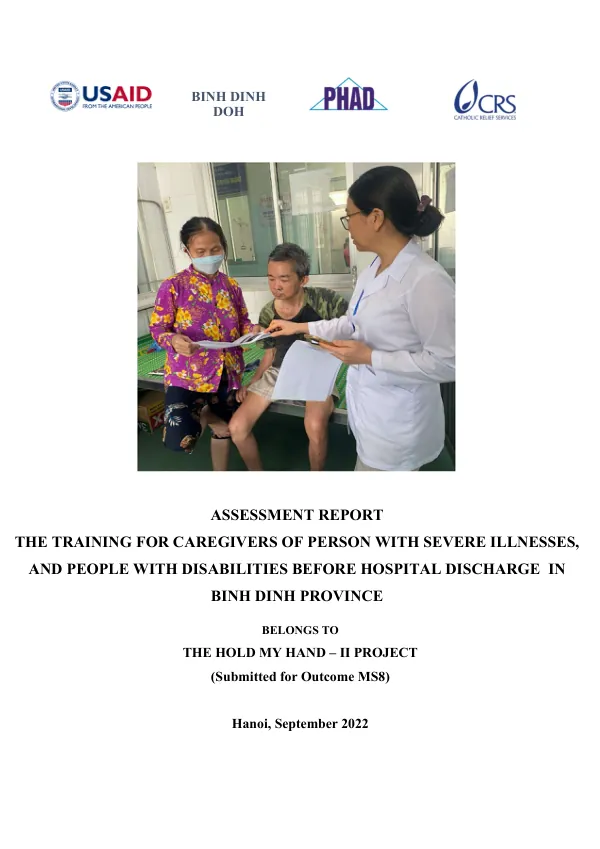
Assessment Report: The training for Caregivers of Person with severe Illness and PWDs before hospital discharge in Binh Dinh Province
Sign inCATHOLIC RELIEF SERVICES ORGANIZATION
Assessment Report: The training for Caregivers of Person with severe Illness and PWDs before hospital discharge in Binh Dinh Province
The training for caregivers of persons with severe illnesses and people with disabilities before hospital discharge in Binh Dinh Province belongs to the Hold My Hand – II Project.
2023 · 26 pages
Sign in to readA free account is required to download.
Abstract
The project aims to improve the quality of life of persons with disabilities through strengthening care and social assistance for persons with severe disabilities in Binh Dinh, Kon Tum, and Quang Nam provinces. In Vietnam, the care process of people with severe illnesses/people with disabilities (NBN/PWD) after hospital discharge is a concern that contributes to the increase in healthcare expenses and workloads for NBN/PWDs and their caregivers (NCS). Stroke can result in numerous types of disabilities, with up to 80% of patients developing multiple disabilities as sequelae. Failing to address these sequelae can result in severe consequences for the mental and physical health of PWDs once they are released from the hospital and begin receiving home care. The Hold My Hand – II Project, implemented by the Institute of Population, Health, and Development (PHAD) and the Catholic Relief Services (CRS) with funding from the United States Agency for International Development (USAID), has coordinated with the Binh Dinh Department of Health and relevant units to develop instructional care skills for NBN/PWDs before hospital discharge videos, and posted on the website of the Traditional Medicine and Rehabilitation Hospital of Binh Dinh. The project also coordinated a pilot implementation of instructional nursing care skills training for NCS, focusing on NBN/PWD's care skills, to equip NCS with the necessary skills to provide care to NBN/PWDs before and after their discharge from the hospital. The objectives of the assessment report are to assess the level at which the mobile provision and guidance of care skills on the website of the Traditional Medicine and Rehabilitation Hospital of Binh Dinh Province contributed to the improvement in daily life functions of NBN/PWDs after their discharge from the hospital, to assess the application of care skills through online learning via smartphones of NCS/NBN/PWDs and the improvement in the quality of life of NBN/PWDs, and to evaluate the change in attitudes and adherence to medication practices of PWDs/people with mental illnesses after receiving care instructions/guidance via smartphone and through the website of the Binh Dinh Provincial Hospital of Traditional Medicine and Rehabilitation. The evaluation methods used in the assessment report include a one-group intervention design with pre- and post-intervention assessments, with no randomization, and no control group. The data obtained from the initial and post-intervention evaluations were entered into Microsoft Form software and then imported into Excel and exported to Python for analysis and evaluation. A collective of 545 patients and caregivers were invited to participate in the initial assessment round, and 493 caregivers of people with severe disabilities completed the evaluation in the second round. The results of the intervention showed that the caregivers who received the training on care skills for NBN/PWDs before hospital discharge demonstrated significant improvement in their ability to perform daily living functions, such as mobility activities, eating, bathing, maintaining personal sanitation, and adhering to medical prescriptions. The caregivers also reported a change in their attitudes and adherence to medication practices of PWDs/people with mental illnesses after receiving care instructions/guidance via smartphone and through the website of the Binh Dinh Provincial Hospital of Traditional Medicine and Rehabilitation. The assessment report concludes that the training on care skills for NBN/PWDs before hospital discharge is an effective intervention in improving the daily life functions of NBN/PWDs and the quality of life of NBN/PWDs. The report recommends that the training program be scaled up and implemented in other provinces to reach more caregivers and NBN/PWDs.
Related documents
Documents in this collection
 2021
2021USAID DEC
Sustainable and Interdisciplinary Rehabilitation Services for Persons with Severe Disabilities in Binh Dinh and Quang Nam Provinces (HOLD MY HAND)
Open record 2019
2019USAID DEC