USAID DEC
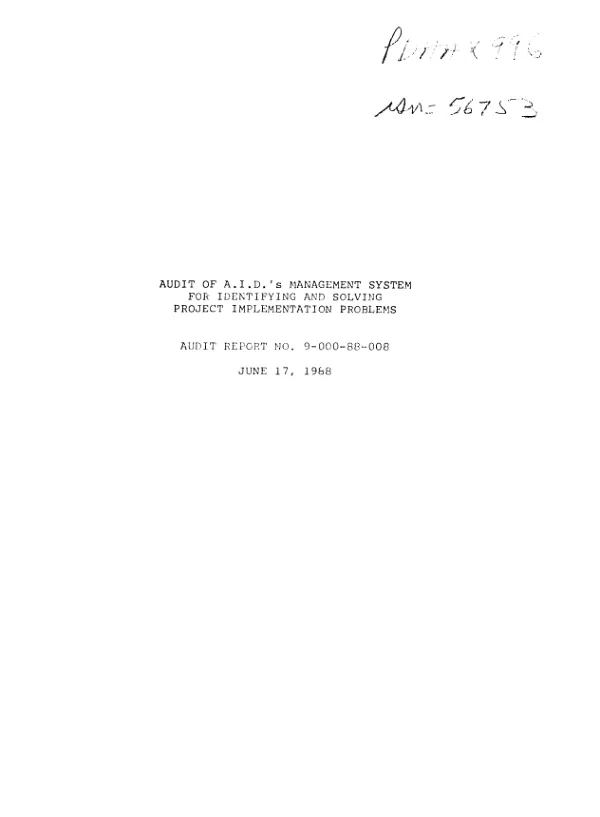
Audit of AID"s management system for identifying and solving project implementation problems
Sign inUSAID. OFC. OF THE INSPECTOR GENERAL. OFC. OF PROGRAMS AND SYSTEMS AUDITS
Audit of AID"s management system for identifying and solving project implementation problems
Audits management systems for identifying and solving project implementation problems in A.I.D.
1988
Sign in to readA free account is required to download.
Abstract
Missions and Bureaus worldwide. Audit covers the period through 7/87. The audit found that Missions had established systems for monitoring their project portfolios and were identifying implementation problems. However, Mission and Bureau management were not always systematic in dealing with the problems that were identified. In many cases problems that had persisted for several years could have been resolved more quickly if the Mission management systems had better defined the problem, clearly fixed responsibility for corrective action, documented actions taken, and tracked the problem until it was satisfactorily resolved. In many cases Missions did not make full use of objectively verifiable indicators to measure progress against plans, ensure that project purposes were being achieved, or demonstrate project impact on the targeted group or area. Often this was because of a lack of a policy requiring data management components to be designed into projects and the concomitant provision of resources to make the components work. As a result, Project Managers did not have the empirical data neccesary to identify and solve problems. Another shortcoming concerned A.I.D."s system for managing its deobligation-reobligation (D/R) authority. Since there are very limited criteria for using the authority and A.I.D. does not have a specific D/R review process, not all Missions systematically and consistently identified potential deobligations. D/R actions could increase by as much as $70 million if all Missions adopted aggressive D/R programs. Finally, Mission directors often extended PACD"s for projects that were essentially complete or that had persistent schedule and quality problems without examining alternative strategies. A.I.D. policy encourages assessments of alternatives before extending PACD"s, but stops short of requiring that alternatives be formally developed. As a result, there is no assurance that funds involved in project extensions have been put to their most productive uses. Seven recommendations are made to address these issues, calling for changes in A.I.D. guidance to ensure (1) better identification and tracking of implementation problems, (2) that design documents specify interim and end of project indicators of project progress, and that (3) potential deobligations are identified and reported in project implementation status reports, and that (4) alternatives to project extensions be formally explored. Agency management essentially concurred with the findings.
Related documents
Documents in this collection
![Financial audit of the Ministry of Health"s Teaching Hospital Organization, expenditures incurred under project implementation letter [PIL] no. 8B under USAID/Egypt"s population/family planning III project (project no. 263-0227)](https://covers.devme.ai/gen/14006.webp) 2000
2000USAID DEC
Financial audit of the Ministry of Health"s Teaching Hospital Organization, expenditures incurred under project implementation letter [PIL] no. 8B under USAID/Egypt"s population/family planning III project (project no. 263-0227)
Open record 2001
2001USAID DEC