USAID. OFC. OF THE INSPECTOR GENERAL. REGIONAL INSPECTOR GENERAL FOR AUDIT
AUDIT OF THE POULTRY IMPROVEMENT PROJECT
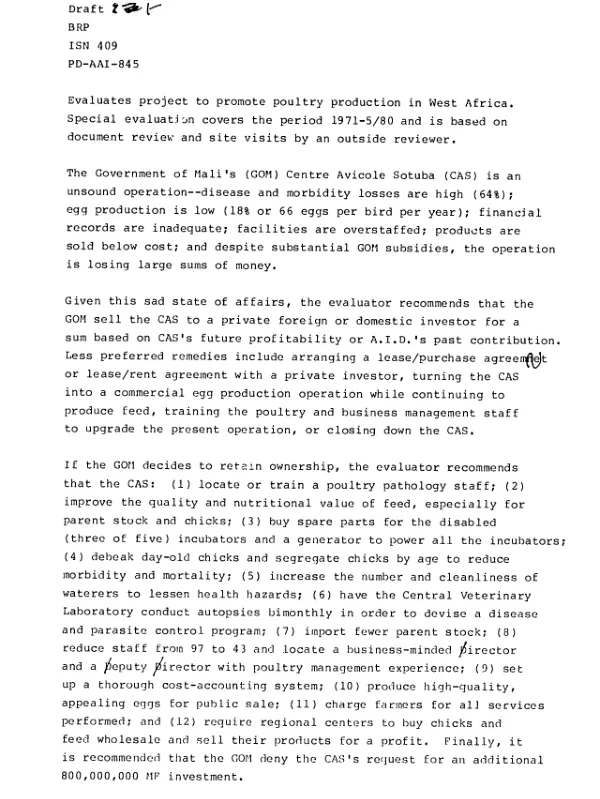
Evaluates project to develop and improve poultry production in Egypt.
1981
Sign in to readA free account is required to download.
Abstract
Evaluation covers the period 8/1/77-4/15/81 and consists of an audit review of project documents, contractors" and sub-contractors" books of account, site visits, and interviews with USAID officials. Planned outputs of the project were to provide technical studies on the poultry sector, to train 76 participant workers, and to improve three Ministry of Agriculture breeding-hatching farms (BHF"s). Auditors found that the contractor, Mathtech Inc. (MI), fulfilled its technical obligations satisfactorily (41 very well qualified technicians provided, 69 participants trained, 24 monthly progress reports, 49 special reports, and a comprehensive final report submitted). Only the BHF improvement component was behind schedule. However, an amendment to the original Project Paper (PP) will extend the BHF improvement component for an additional 2 years, in which time project developers expect to complete original PP goals and extend the program to three more BHF"s. Auditors found serious improprieties in MI"s financial accounting of the project. Of $2,104,214 and LE 328,326 claimed by MI for reimbursement, evaluators recommended only $1,943,573 and LE 272,849 for acceptance. The majority of the disallowances represent costs not paid to employees, fringe benefits, indirect costs, and general and administrative costs. Other disallowances include: claims for per-diem (PD) in excess of that authorized by regulations, claims of PD in $US rather than local currency; and payment for consulting services not approved by USAID. No opinion was expressed on $74,866 and LE 45,251 due to insufficient information or unclear guidelines on subcontracting costs. Auditors recommend: (1) that USAID, in concert with the Government of Egypt, resolve questions on the costs on which auditors took no opinion; 2) that A.I.D."s Office of Contract Management review and have audited all A.I.D. contracts with MI, suspend all work not considered critical until MI takes remedial action, and make future contracts with MI dependent on proof of remedial action.