USAID. OFC. OF THE INSPECTOR GENERAL. REGIONAL INSPECTOR GENERAL FOR AUDIT. CAIRO
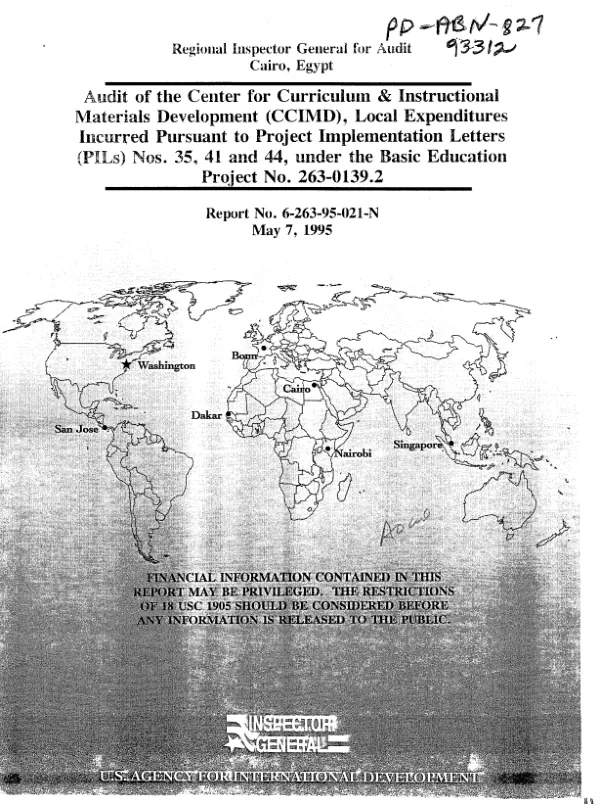
Audit of USAID/Egypt"s basic education project no. 263-0139
Audit of a project to improve basic education and expand school enrollments among rural Egyptian youth through school building construction.
1992
Sign in to readA free account is required to download.
Abstract
The audit covers the period 8/81-10/91. The project has succeeded in constructing more than 1,800 schools, increasing enrollments by about 1 million students, and making schools available where there were none before. However, the Mission did not provide the monitoring and reporting information necessary to ensure that schools were properly constructed and maintained. As a result, there has been widespread substandard construction, a lack of maintenance, and a lack of basic utilities such as electricity, sewer, and water. These problems went unabated and largely unreported for years. It is unclear as to how the Mission could have been unaware of these problems, except that it seems to have been concerned only with building production rather than the quality of construction or maintenance. USAID/E also failed to ensure that A.I.D.-financed materials and equipment were accounted for and utilized in accordance with A.I.D. requirements. As a result, about $40 million in A.I.D. project and Commodity Import Program funds have been expended for equipment and instructional materials that have not been adequately utilized and may not even be appropriate for the project; for example, power tools, butane stoves, and sophisticated lab equipment were distributed to primary as well as to preparatory schools. A sample of schools indicated that about half of equipment provided, much of it still in the original cartons, was not being used, either because the school had insufficient resources to make use of the equipment or because the equipment did not fit into the curriculum. The problem was primarily due to the Mission"s failure -- despite the 1987 audit"s criticism of the Ministry of Education"s inadequacy in this area -- to plan for procurement and to establish commodity control systems to account for the receipt, storage, distribution, and use of the equipment and instructional materials. Mission officials concurred with recommendations made by the audit to address the above deficiencies and outlined substantive actions already taken to correct them. The Mission also indicated that it will finance neither additional construction of new schools nor a follow-on project.
Related documents
![Audit of costs incurred by United Engineering and Marketing Co. under USAID/Egypt contract no. 263-CSO-C-00-0008-00 [i.e. 263-0000-C-00-0008-00]](https://covers.devme.ai/gen/22491.webp)