USAID DEC
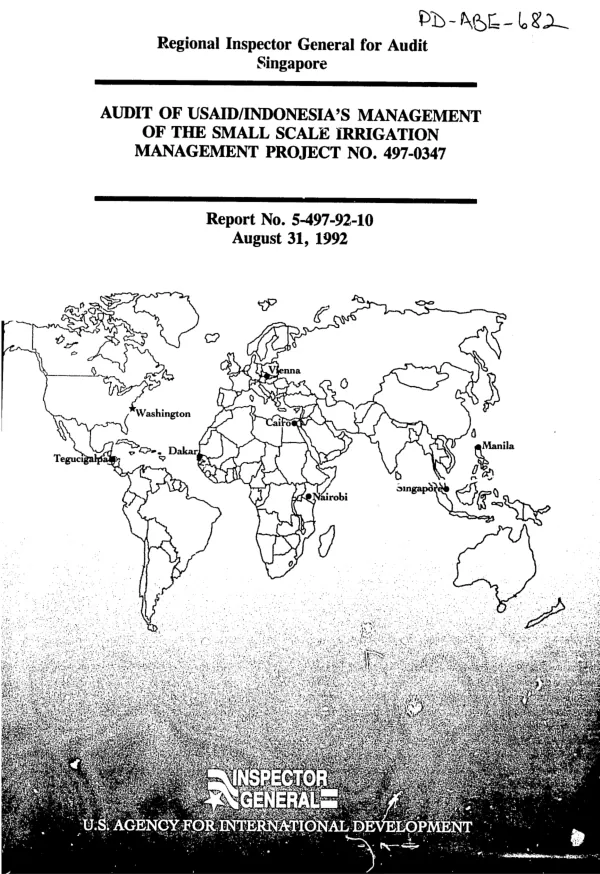
Audit of USAID/Indonesia"s management of the small scale irrigation management project no. 497-0347
Sign inUSAID. OFC. OF THE INSPECTOR GENERAL. REGIONAL INSPECTOR GENERAL FOR AUDIT. SINGAPORE
Audit of USAID/Indonesia"s management of the small scale irrigation management project no. 497-0347
USAID authorized the $90 million Small Scale Irrigation Management Project to design, test, and apply irrigation technologies and management systems in three Indonesian provinces (South Sulawesi, Nusa Tenggara Barat, and Nusa Tenggara Timur).
1992
Sign in to readA free account is required to download.
Abstract
The project began in 1985 and is scheduled to end in 1993. As of 9/91, USAID had obligated $37 million and expended $13 million. After 6 years of implementation, the project is still encountering difficulties in producing economic benefits. It is several years behind schedule in meeting project objectives, and at least 5 years behind in constructing irrigation systems. For example, of ten surface water systems to be constructed by 1991, construction has begun on only one. Of the planned 5,200 ha (12,849 acres) of land to be irrigated through groundwater irrigation systems, only 38 ha (94 acres) have been irrigated. Mission monitoring and a 1989 evaluation found that an overly optimistic project design partly accounts for the limited progress in accomplishing project objectives. USAID/I, however, changed the project objectives without (l) preparing the necessary analyses, (2) submitting the required justification, and (3) obtaining necessary authorization. By 1991, a decrease of more than $26 million in host country contributions and other issues had not been presented to USAID/Washington for a decision on whether to terminate or redesign the project. Weaknesses in USAID/I"s controls over TA, training, and commodities also contributed to the limited progress. The Mission expended $9.6 million for TA but neither established clear performance standards for contractors nor held contractors to reporting requirements. Furthermore, although USAID expended $817,000 to strengthen the capability of the implementing institution through overseas training of 29 staff, the Indonesian Government assigned only 10 of the 29 to full-time project positions after the completion of training. Also, the Mission did not obtain reports from the Indonesian Government on the use of vehicles which cost USAID $231,000. The limited project progress was not sufficiently and accurately reported to USAID/Washington and USAID/I officials. The Mission did not fully follow USAID procedures for reporting key programmatic and project issues. More reliable reporting could have helped the Mission or USAID/Washington make key decisions to resolve the long-standing issues. To help support key decisions affecting project implementation, USAID has established an evaluation function. However, USAID/I established evaluation procedures which were inconsistent with USAID procedures. The Mission did not design the 1989 evaluation to address all critical issues affecting project implementation. Furthermore, the Mission did not clearly define some performance standards for the evaluation team and did not hold the team accountable for other standards -- expending $90,000 for an incomplete report. Moreover, in processing the evaluation report, the Mission did not (l) ensure the accuracy of the evaluation, (2) prepare a proper evaluation summary for USAID/Washington, and (3) establish the required system for resolving the evaluation report"s recommendations. The audit report contains six recommendations. The report also assesses internal controls and compliance with legal requirements. In disagreeing with the tone of the report and with the auditors" interpretation of facts, USAID/I emphasized that it had: (1) reviewed project progress and conducted numerous field trips regarding the design of the 1989 evaluation, an evaluation which met the Mission"s purpose and was in accord with USAID procedures; (2) established a strong system of informing management of project progress and issues, and made its best efforts to respond to reporting requirements for data which were not always available, while noting that the Asia Bureau delegated primary responsibility for project implementation to the Mission, retained only general oversight responsibility, and had not indicated dissatisfaction with Mission reporting; (3) took major and responsible corrective actions, including decisions to reduce the number of project activities and to establish a series of critical deadlines for accomplishing key project implementation actions; and (4) made a decision to concentrate on expediting project implementation rather than spend time drafting a project paper amendment. (Author abstract)