USAID DEC
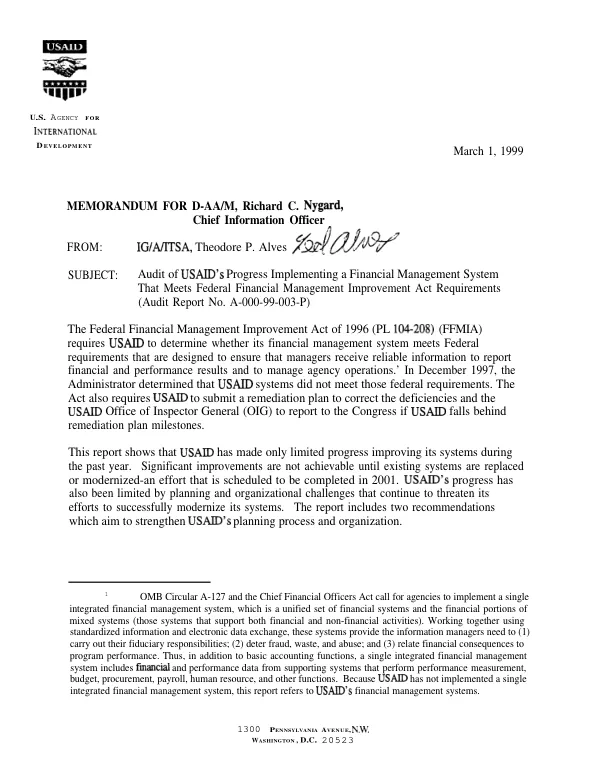
Audit of USAID"s progress implementing a financial management system that meets Federal Financial Management Improvement Act requirements
Sign inUSAID. OFC. OF THE INSPECTOR GENERAL. OFC. OF AUDIT. INFORMATION, TECHNOLOGY & SPECIAL AUDITS DIV.
Audit of USAID"s progress implementing a financial management system that meets Federal Financial Management Improvement Act requirements
Audits USAID"s progress in implementing federal requirements to ensure that managers receive the information needed to report financial and performance results and to manage agency operations.
1999
Sign in to readA free account is required to download.
Abstract
Audit report covers the period 3/98-2/99. USAID has made only limited progress improving its systems during the past year. Significant improvements are not achievable until existing systems are replaced or modernized -- an effort that is scheduled to be completed in 2001. USAID"s progress has also been limited by planning and organizational challenges that continue to threaten its efforts to successfully modernize its systems. The report includes two recommendations which aim to strengthen USAID"s planning process and organization. In response to the draft audit, USAID stated that agency management agrees with the Office of Inspector General about the processes, plans, and documentation needed to deploy a financial management system that meets federal requirements. USAID also stated that the draft audit conveys a general tone of non-compliance and gives the impression that the agency is repeating earlier mistakes. Management also believes the report does not acknowledge the dilemma it faces in trying to balance the risk of an acquisition based on less than a full architecture with its goal of having a new core financial system deployed in Washington by FY 2000. The auditors replied that USAID properly characterized the tone of the report, which reflects the auditors" concerns that past mistakes were being repeated. The report points out several parallels with the approach USAID followed in acquiring the New Management System (NMS), a system that did not operate effectively. They include: (1) lack of an agency-wide blueprint before beginning development; (2) acquisition of a core financial system in isolation from other financial and mixed financial systems; and (3) lack of a comprehensive acquisition strategy supported by sufficiently detailed plans. The auditors are encouraged by management"s comments, which indicate general agreement to modify the approach, but believe that USAID"s dilemma between completing an architecture and meeting its goal of deploying a core financial system by the year 2000 should be resolved based on an analysis of risks. USAID"s approach -- to purchase the core financial system before completing an agency-wide architecture and acquisition strategy, and without a strong program office -- creates significant risks. To illustrate, one factor contributing to NMS problems was that USAID took shortcuts in reaction to perceived schedule pressures. For example, even though responsible officials urged management to postpone deployment until problems were corrected, USAID deployed the system worldwide in October 1996 in order to meet its deployment schedule. Based on its experience with NMS, USAID has committed to follow disciplined practices in order not to repeat those mistakes. However, because USAID has not yet prepared a realistic risk adjusted schedule, it is not in a position to know whether its schedule goals are achievable. In the view of the auditors, a choice between following disciplined practices and meeting scheduled goals should be decided in favor of following disciplined practices. (Author abstract, modified)