USAID DEC
Auditing of Financial Statements
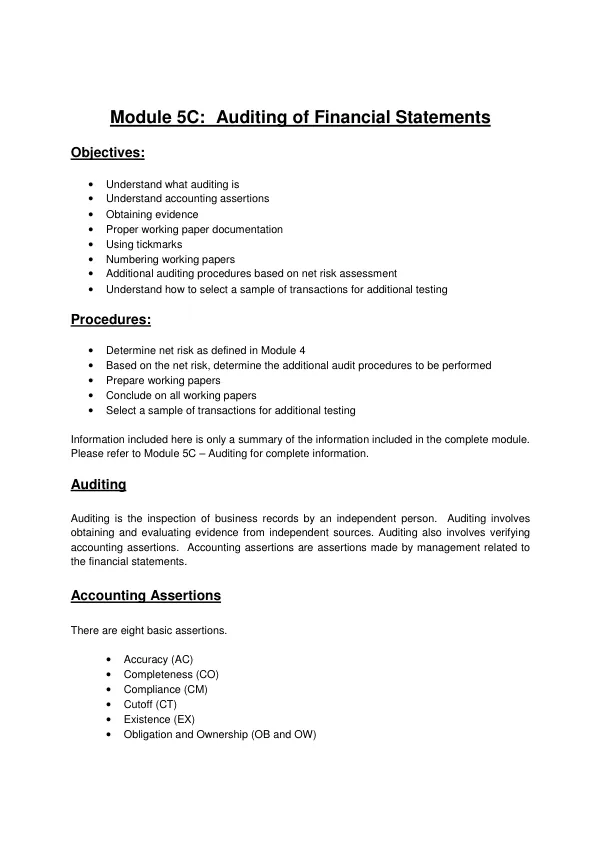
Auditing is the inspection of business records by an independent person.
3 pages
Sign in to readA free account is required to download.
Abstract
This process involves obtaining and evaluating evidence from independent sources to verify accounting assertions made by management related to the financial statements. Accounting assertions are assertions made by management regarding the accuracy, completeness, compliance, cutoff, existence, obligation and ownership, valuation, and presentation and disclosure of financial information. There are eight basic assertions that auditors must verify. These include accuracy, completeness, compliance, cutoff, existence, obligation and ownership, valuation, and presentation and disclosure. Auditors must obtain evidence to support these assertions, which can be written, verbal, or observational in nature. Proper working paper documentation is essential for demonstrating professionalism and documenting the work done for the account being audited. The degree of documentation is based on the judgment of the inspector and the adequacy and effectiveness of controls. Working papers should contain sufficient information to allow an experienced inspector to ascertain the evidence that supports the inspector's significant conclusions and judgments. General guidelines for the preparation of working papers include completeness and accuracy, clarity and understanding, pertinence, logical arrangement, and legibility and neatness. Tickmarks are used to simplify documenting work done and conditions found, and a legend that defines each tickmark should be placed on the working paper. Tickmarks should be concise and adequately explain the results of the audit procedures performed. Working papers should be numbered to identify their location, and working papers within the same item should be numbered in a similar format. The amount of additional auditing required for a Significant Activity depends on the net risk assessment, which is calculated based on the probability of a material adverse impact on capital and earnings in the foreseeable future. If the net risk assessment is low, no additional auditing is required. If the net risk assessment is moderate, some additional auditing steps will need to be performed to offset the moderate risk. If the net risk assessment is high, many additional auditing steps will be necessary to reduce the risk. Sampling is used to select a representative subset of transactions for additional testing, and there are two basic methods for calculating the sample size: the asset method and the liability and income and expense method.