THE WORLD RESOURCES INSTITUTE
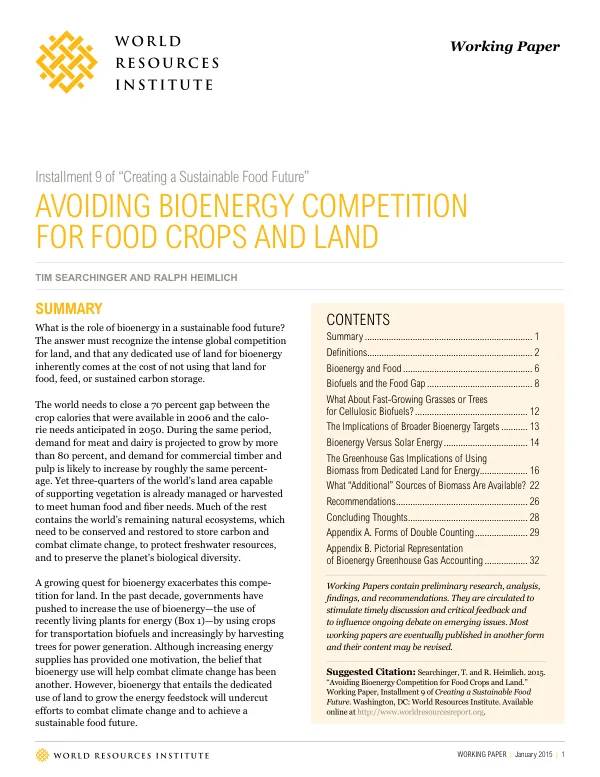
Avoiding Bioenergy Competition for Food Crops and Land
The global competition for land is intense, and any dedicated use of land for bioenergy inherently comes at the cost of not using that land for food, feed, or sustained carbon storage.
2015 · 44 pages
Sign in to readA free account is required to download.
Abstract
The world needs to close a 70 percent gap between the crop calories that were available in 2006 and the calorie needs anticipated in 2050. During the same period, demand for meat and dairy is projected to grow by more than 80 percent, and demand for commercial timber and pulp is likely to increase by roughly the same percentage. The use of bioenergy exacerbates this competition for land. In the past decade, governments have pushed to increase the use of bioenergy by using crops for transportation biofuels and increasingly by harvesting trees for power generation. Although increasing energy supplies has provided one motivation, the belief that bioenergy use will help combat climate change has been another. However, bioenergy that entails the dedicated use of land to grow the energy feedstock will undercut efforts to combat climate change and to achieve a sustainable food future. Bioenergy challenges a sustainable food future most directly when government policy causes diversion of food crops into ethanol or biodiesel for transportation. Biofuels from food crops today provide about 2.5 percent of the world's transportation fuel. Crop needs for 2050 projected by the Food and Agriculture Organization of the United Nations (FAO) assume that this penetration rate will remain roughly the same. Yet even this small share of transportation fuel in 2050 would have substantial implications for the crop calorie gap. If crop-based biofuels were phased out, the 2050 crop calorie gap would decrease from 70 percent to about 60 percent, a significant step toward a sustainable food future. Cellulosic biofuels may use crop residues or other wastes, but most plans for these biofuels rely on planting and harvesting fast-growing trees or grasses. At least some direct competition with food is still likely because such trees and grasses grow best and are most easily harvested on relatively flat, fertile lands—the type of land already dedicated to crops. Using cropland to grow trees and grasses rather than food crops for biofuels will probably not reduce, let alone eliminate, competition for cropland. Some researchers argue that growing bioenergy feedstocks on degraded lands would avoid competition for land. However, it is hard to find lands that are doing little today for people, climate, or biodiversity and that could produce bioenergy crops abundantly. There are a few possible candidates, such as cleared forests of Indonesia that are overrun by alang-alang grasses. But while some of these lands could support bioenergy plants, the opportunity costs of doing so are high in a world that needs at least 70 percent more crops, livestock, and commercial timber by 2050. Increased crop and pasture yields may supply bioenergy as part of a sustainable food future. However, this would require significant increases in yields, which are unlikely to be achieved without substantial investments in research and development, as well as changes in agricultural practices. Moreover, even if yields were to increase, the competition for land would remain a significant challenge. The greenhouse gas implications of using biomass from dedicated land for energy are significant. Biomass from dedicated land can lead to net carbon dioxide emissions for decades until the trees regrow. Converting woody savannas to bioenergy sacrifices the ecosystem's abundant carbon storage and biodiversity, while converting pasturelands sacrifices their ability to provide food from livestock. In conclusion, the use of bioenergy for transportation fuels poses significant challenges to achieving a sustainable food future. The competition for land is intense, and any dedicated use of land for bioenergy will undercut efforts to combat climate change and to achieve a sustainable food future. Phasing out the use of crop-based biofuels instead of meeting an expanded 10 percent target is likely to mean the difference between a 90 percent crop calorie gap and a 60 percent gap.