KAIZEN CO., LLC
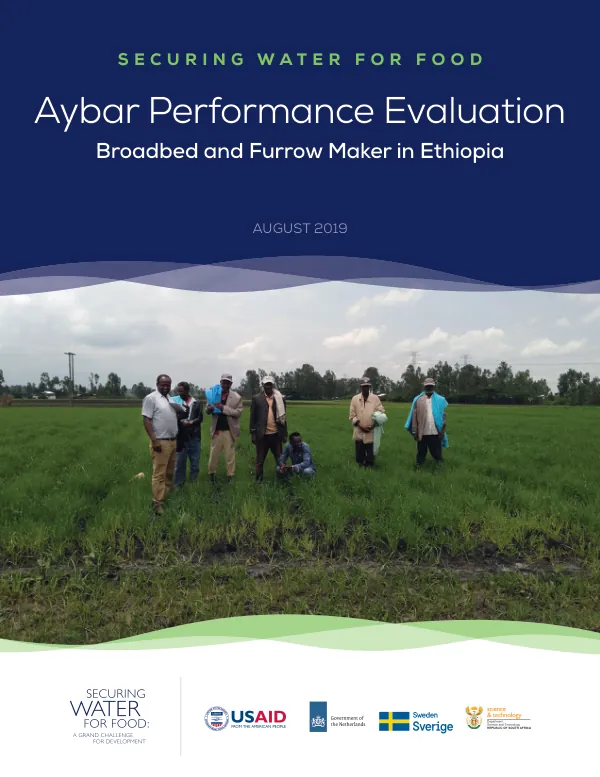
Aybar performance evaluation : broadbed and furrow maker in Ethiopia
Aybar Broad Bed and Furrow Maker was a Securing Water For Food (SWFF) supported agricultural innovation project targeting the pressing challenge of waterlogging in Vertisols of Ethiopia.
Ogeto, Mohammed · 2019
Sign in to readA free account is required to download.
Abstract
This report presents impact analysis results conducted in July and August, 2019, in West Shewa Zone of Oromia National Regional State in Ethiopia. Farmers have been using the innovation for four years. A total of 50 end users (46 male and four female) of the innovation were individually interviewed from nine villages in West Shewa Zone. In consultation with West Shewa Zone Bureau of Agriculture, the lists of innovation adopting villages were identified. Accordingly, nine villages were purposively selected from the zone and used for this performance evaluation study. Data was collected on farm information, income, expenditures, and perceptions on the innovation. Gender observations and questions raised by respondents also are included in this report. Wheat and Teff are cereals mainly grown in the study area. However, Aybar Broad Bed and Furrow Maker (Aybar BBM) is solely used for growing wheat. Following adoption of the innovation, row-planting of Teff is practiced. The mean farm size of sampled respondents is six acres with minimum and maximum sizes of 1.23 acres and 14.82 acres, respectively. After the innovation, the average yield of wheat increased by 115 percent (from 0.26 MT/acre to 0.57 MT/acre). The average annual farm income of end users before the innovation was 10,313 Ethiopian Birr (ETB) (approximately USD 362). It increased to 24,155 ETB (approximately USD 847) after the innovation. Despite reduced waterlogging, no crop diversification is practiced due to the innovation. Reducing the unit price of Aybar BBM (currently USD 12) and an adequate supply of the innovation that can be used for other crops other than wheat are requested by end users in the study area. Strong commitment is needed by the innovator and higher officials in the Ministry of Agriculture to resolve the indirect and controlled supply of the innovation to end users in the study area. Otherwise, continued dissemination of the innovation is challenging.