USAID DEC
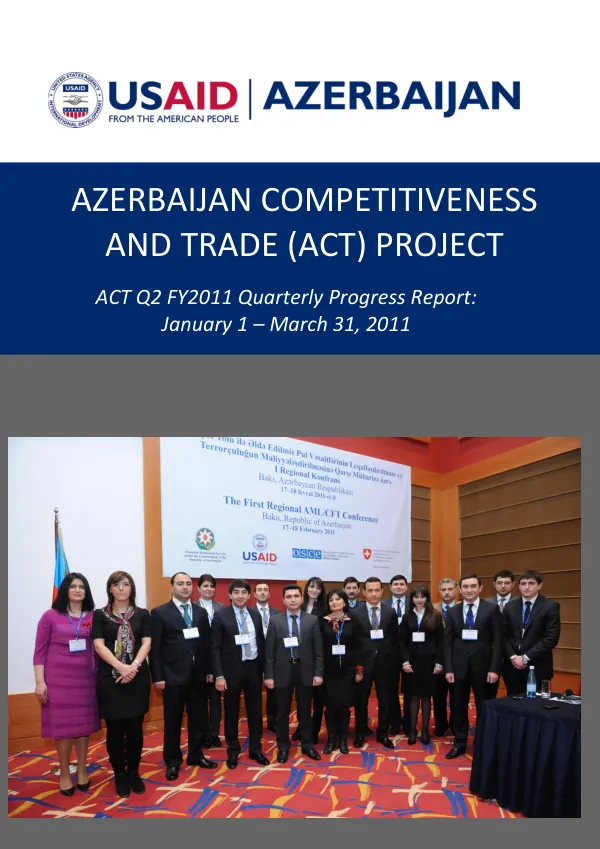
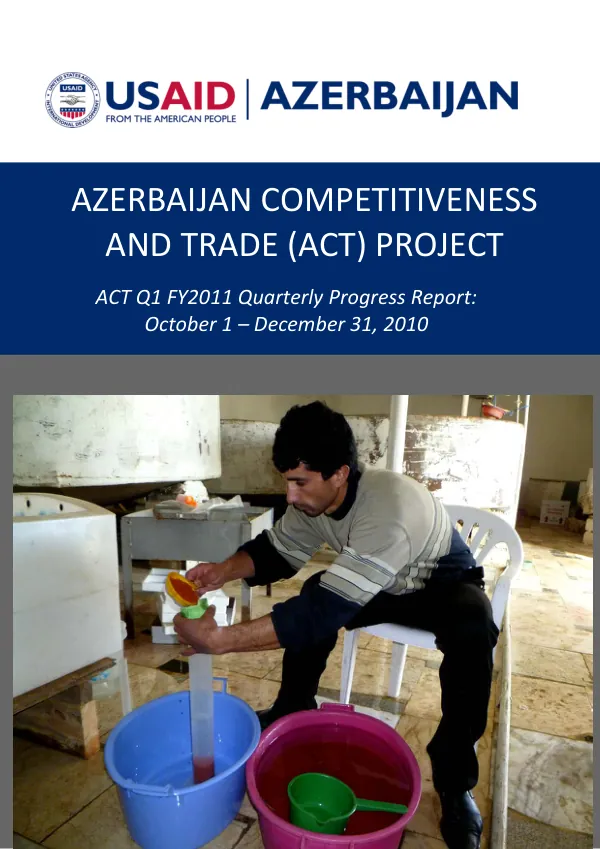
Azerbaijan Competitiveness and Trade (ACT) Project ACT Q1 FY2011 Quarterly Progress Report
Sign inUSAID
Azerbaijan Competitiveness and Trade (ACT) Project ACT Q1 FY2011 Quarterly Progress Report
The Azerbaijan Competitiveness and Trade (ACT) Project aims to improve the domestic business enabling environment, develop a liberalized, more transparent trade environment, and enhance targeted value chains in the agriculture sector of Azerbaijan.
2011 · 19 pages
Sign in to readA free account is required to download.
Abstract
The project is divided into three interconnected components: Domestic Business Environment Improved, Liberalized, More Transparent Trade Environment Developed, and Targeted Agricultural Value Chains Improved. Component 1: Domestic Business Environment Improved focuses on building a public dialogue, improving domestic business-related legislation and public expenditure, institutionalizing knowledge, and improving the financial sector. In Q1 FY2011, the team completed a significant portion of the assessment of Civil Society Organizations (CSOs) and met with twenty CSOs and two local universities to gauge their capacity for rigorous research and credibility with government, private sector, media, and society. A model first draft of the Competition Code was also completed and presented for comments at a public outreach event. Component 2: Liberalized, More Transparent Trade Environment Developed aims to support the Government of Azerbaijan (GOAJ) on WTO accession, improve anti-money laundering, and quantify costs of the current trade regime. In Q1 FY2011, the team provided technical assistance to the GOAJ on WTO accession and supported the development of a public-private dialog to facilitate discussions between the private and public sector. Component 3: Targeted Agricultural Value Chains Improved focuses on identifying sub-sectors that exhibit potential for competitive growth, improving competitiveness of targeted sub-sectors, and improving knowledge of agricultural best practices. In Q1 FY2011, the team conducted a study to identify sub-sectors that exhibit potential for competitive growth and developed a plan to improve competitiveness of targeted sub-sectors. The project also includes several cross-cutting technical areas that support all three components, including institutionalization of education related to trade, investment, and agriculture, development of a public-private dialog, analysis of costs of various initiatives, overall monitoring and evaluation, and development and implementation of a grants program to support the development of partner organizations in building local institutional capacity. The project's overall objectives are to achieve a broad-based understanding and acceptance of the need for an improved domestic business environment and a liberalized, more transparent trade environment, involving businesses, universities, associations, alliances, public sector, etc. The project also aims to improve domestic business environment and trade-related laws, leading to an improved investor and trade climate, and to increase exports through implementing rules and regulations transparently enforced.
Related documents
Documents in this collection
 2011
2011USAID DEC
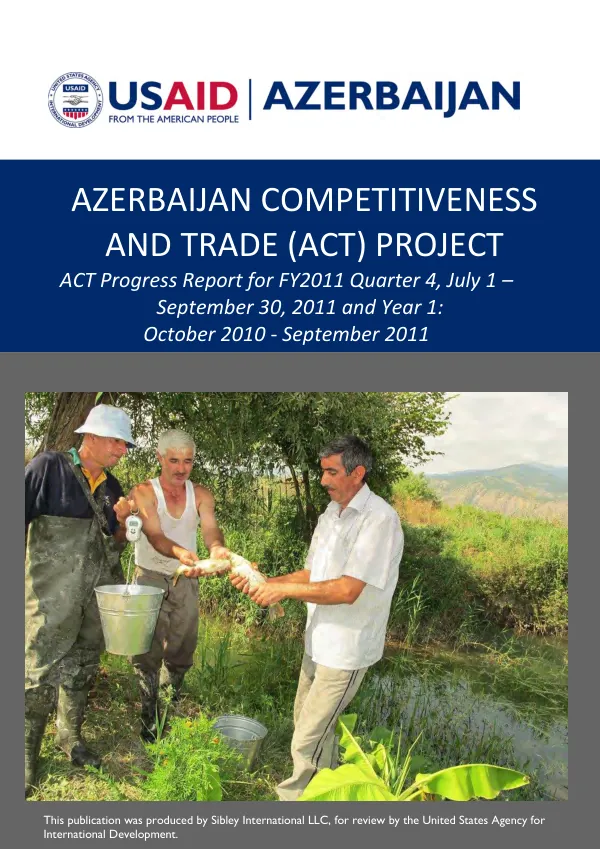
AZERBAIJAN COMPETITIVENESS AND TRADE (ACT) PROJECT ACT Progress Report for FY2011 Quarter 4, July 1 – September 30, 2011 and Year 1: October 2010 - September 2011
Open record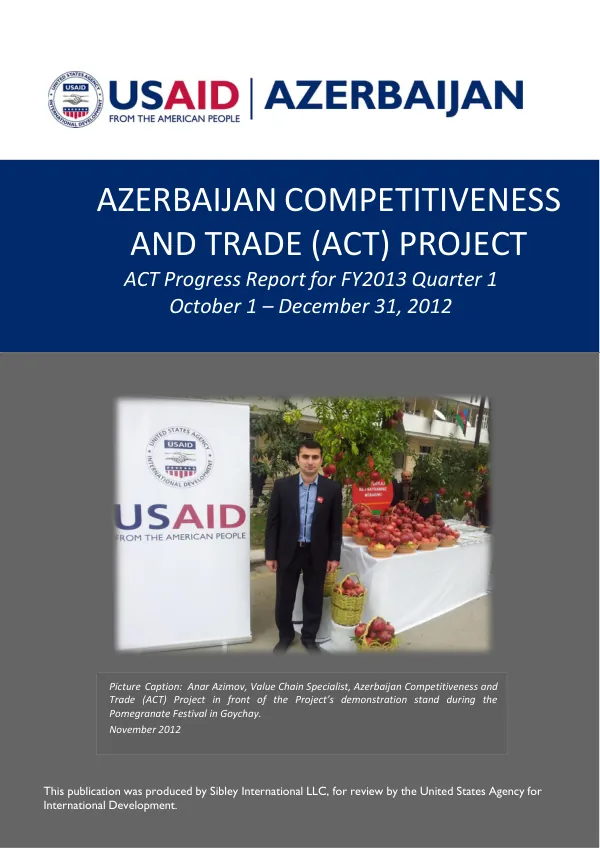 2013
2013USAID DEC
AZERBAIJAN COMPETITIVENESS AND TRADE (ACT) PROJECT ACT Progress Report for FY2013 Quarter 1
Open record