USAID DEC
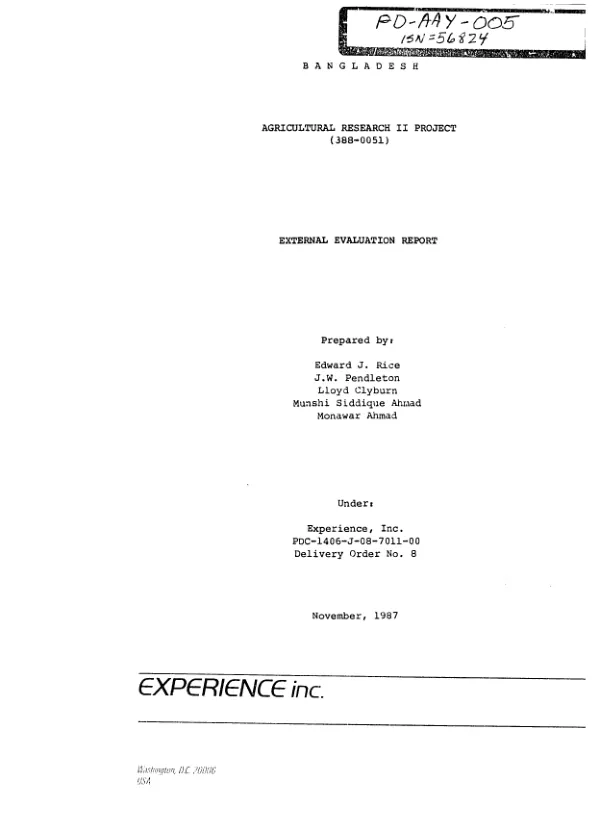
Bangladesh, agricultural research II project (388-0051) : external evaluation report
Sign inEXPERIENCE, INC.
Bangladesh, agricultural research II project (388-0051) : external evaluation report
Evaluates project to strengthen agricultural research (AR) in Bangladesh.
Rice, Edward J.|Pendleton, J. W. · 1987
Sign in to readA free account is required to download.
Abstract
Final evaluation covers the period through 11/87. Results are mixed. The Bangladesh AR Council (BARC) has become more effective in working with the nation's semi-autonomous AR institutes and in coordinating the drafting of a long-range, unified, national AR plan. It has also successfully managed contract research and P.L. 480 funds for the institutes, helped to shift AR focus to cropping systems and farming systems research (CSR/FSR), and sponsored an impressive number of seminars and workshops. There remains room for improvement in all BARC services, however (particularly information management and training coordination). Project targets for overseas training were met, but to little avail, as all of the returned participants were assigned to BARC or Agricultural Research Institute headquarters, none to the regional AR stations or FSR work. AR outputs varied: crops research was fairly successful, vegetable research unsatisfactory, livestock research nonexistent. The new soil and plant analysis lab had only a limited impact, and although the project contractor made several water management recommendations, none were implemented. CSR was a success, resulting in some useful farmer technology. However, the current move toward a more complex, 24-site FSR program is too ambitious, given the cost of FSR and the limited in-country training which field scientists have received (training in economic analysis stopped when the contractor left; training in social systems analysis was never provided). Finally, the project's women in development (WID) component was virtually ignored. Recommendations are made to improve BARC services, encourage BARC scientists to perform field work, strengthen training, and improve the FSR and WID components. In sum, while the project's objectives of creating a coordinating Agricultural Research Council, training scientists, and promoting FSR are valid goals, these are novel ideas in Bangladesh and will take more time than anticipated. The BARC training unit must be given more authority and resources if it is to meet national AR needs. Similarly, once trained, scientists must perform field work, if AR is to have any impact on rural farmers. The project also teaches that FSR is expensive, demands strong inputs form conventional AR centers, and takes longer to develop than other forms of AR. Because of its complex organizational problems, FSR has seldom been successfully institutionalized on a national basis. Finally, if WID components are to have any success at all, there must be an agreement among all parties to create a program of on-farm trials with women participants, staffed by women scientists.