USAID DEC
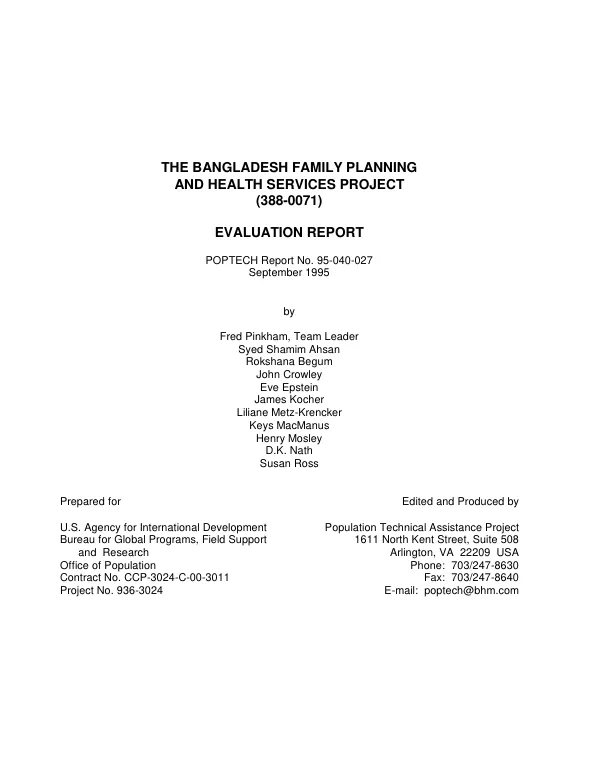
Bangladesh family planning and health services project (388-0071) : evaluation report
Sign inBASIC HEALTH MANAGEMENT INTERNATIONAL (BHM)
Bangladesh family planning and health services project (388-0071) : evaluation report
Evaluates project to improve access to and use of family planning and maternal and child health (FP/MCH) services in Bangladesh.
Pinkham, Fred|Ahsan, Syed Shamim · 1995
Sign in to readA free account is required to download.
Abstract
Interim evaluation covers the period 8/87-8/95. The project, one of the largest of its kind in the world, has significantly supported the Bangladesh National FP Program, especially by strengthening the private sector, and clearly demonstrates the power of USAID's intellectual and technical leadership in this arena. Overall, objectives have been achieved or exceeded. The total fertility rate (TFR) decreased from 5.8 in 1986 to 3.4 in 1993/94 versus a goal of moving from 4.6 in 1991 to 3.8 in 1997. The infant mortality rate (IMR) declined from 117 to 87 per 1,000 between the early 1980s and the early 1990s versus a goal of moving from 118 in 1991 to 107 in 1997, while the contraceptive prevalence rate (CPR) increased from 25.3% in 1986 to 44.6% in 1993/94 versus a goal of moving from 40% in 1991 to 50% in 1997. The CPR for modern methods essentially doubled between 1986 and 1993/94, from 18.4% to 36.2%. The number of contraceptive users was estimated at 10.1 million in 1994; the goal is to move from 7.8 million in 1991 to 12.1 million in 1997. Another goal is to increase the immunization of urban women and children from 25% in 1988 to 85% in 1997. In 1994, the number of urban women immunized with two doses of tetanus toxoid (TT) was 82%. Urban immunization rates for children aged 12-23 months in the same year were 93% for BCG, 83% for DPT, 76% for measles, and 75% for full immunization. Additionally, the under-five mortality rate declined from 180 to 133 between the early 1980s and the early 1990s. While it is unknown whether the maternal mortality rate has changed, it is clear that the number of maternity-related deaths has been much lower due to the fertility decline: if the TFR were still over 7, about 200,000 women who are alive today would have died from a maternity-related cause. The Local Initiatives Program has successfully improved local capacity to manage FP services, and has fostered community ownership of and responsibility for FP/MCH services. Supply management has been improved through the training of over 11,000 workers in logistics management, although institutionalization of this ability within the FP Directorate (DFP) has been slow; efficiency also needs improvement. The urban Expanded Program of Immunization (EPI) has successfully integrated multiple sources to set up fixed and outreach EPI centers, although the projected doubling of the urban population in the next 10 years makes urban health systems a urgent priority. The component to improve satellite clinics was never implemented. The Social Marketing Company, the largest of its kind anywhere, made impressive progress between 1984 and 1994; it has already achieved end-of-project goals with respect to couple years of protection and condom and oral rehydration solution sales and is on track in training regional medical practitioners, though behind in training pharmacists and school children. NGOs have been key innovators in advancing the national program and influencing national policy, and the network of 115 NGOs providing FP/MCH services at 322 sites served 1.7 million users in 1994. NGOs have been particularly instrumental in expanding access to services for underserved groups and in expanding coverage both at existing sites and geographically. Key achievements of the support component have included provision of $7.1 million worth of contraceptives since 1987, and support for construction of 210 storerooms; a number of significant research and evaluation studies; and an impressive IEC program. The project's complexity and variety of local and international development partners make management very labor-intensive. A follow-on project, which is recommended, should adopt a far simpler management structure and allow for more flexibility in allocating resources and a streamlined decision making process.
Related documents