USAID. MISSION TO BURUNDI
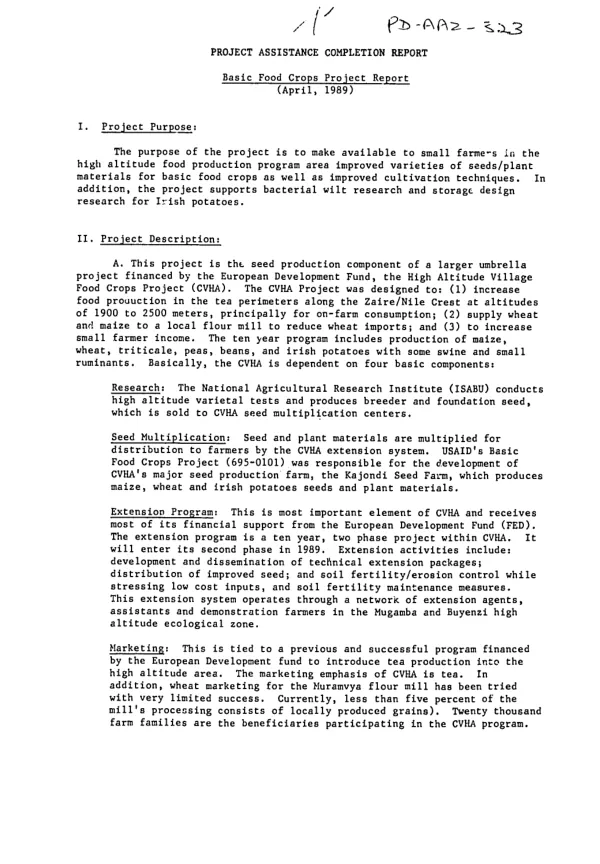
Basic food crops project (695-0101) : evaluation
Evaluates project to provide improved seeds and cultivation methods to farmers in Burundi's highlands.
Blumgart, John D.|Adams, Robert D. · 1984
Sign in to readA free account is required to download.
Abstract
Mid-term evaluation covers 1980-4/84 and is based on site visits, document review, and interviews with USAID/B, donor agency, and Government of the Republic of Burundi (GRB) personnel. Early setbacks in preparatory activities (i.e., contracting TA, recruiting staff, procuring equipment, constructing facilities) have delayed project implementation, especially the development and operation of the Kajondi seed farm. Production of improved seeds - for corn, wheat, and potatoes - has just been started and at much greater than anticipated cost. Seed distribution through the companion High Altitude Food Crop Production (CVHA) project has also been delayed due to CVHA's late start-up and poor TA. Project planning and management is inadequate. Recordkeeping and accounting procedures at the Kajondi farm are poor, despite earlier recommendations to improve them, and have made project monitoring difficult; also, little has been done to evaluate the farm's impact in the larger context (e.g., benefits to small farmers). Daily farm operations have been undermined by problems recruiting adequate TA and managers and have resulted in, inter alia, failure to meet planting schedules. In addition, the low levels of competence, language skills, and commitment on the part of U.S. advisors have exacerbated the farm's problems. Finally, USAID/B's project management has been short-sighted. By focusing its energies on ad hoc solutions to daily implementation crises, USAID/B has forfeited its control over the project's overall direction. Problems with high staff turnover and difficulties in recruiting replacements have been persistent; as a result, much of the project's supervision has been relegated to non-agricultural personnel, and U.S. technical advisors are virtually unsupervised. Despite these shortcomings, the project supports the GRB's high priority, high visibility efforts to increase food production and warrants A.I.D.'s continued support. A.I.D. should: (1) fund the project through FY86 and postpone for 1 year the GRB's commitment to finance half of the project's operating costs; and (2) make major improvements in farm management and project implementation, recordkeeping, and monitoring. Detailed recommendations and yardsticks for measuring progress are given.
Related documents