UNIVERSITY OF MICHIGAN. CENTER FOR RESEARCH ON ECONOMIC DEVELOPMENT
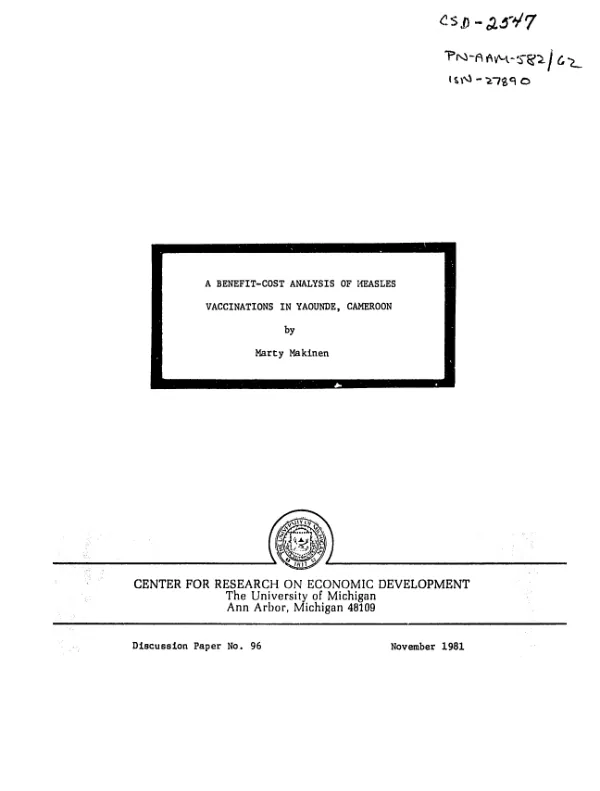
Benefit-cost analysis of measles vaccinations in Yaounde, Cameroon
Benefit-cost analysis, commonly used to assess the effectiveness of industrial projects, is being increasingly used to evaluate health programs.
Makinen, Marty · 1981
Sign in to readA free account is required to download.
Abstract
This paper analyzes the conceptual problems involved in using benefit-cost analysis and develops a methodology to handle them, using as an example the 1971-76 measles vaccination campaign in Yaounde, Cameroon. Four categories of costs are assigned to measles incidence and four to vaccination costs. The benefits of avoiding measles and the costs of giving vaccinations are linked by an epidemiological model which shows how many cases of measles are prevented by each vaccination. Results show that the vaccination program was socially profitable and that increased vaccinations would have resulted in even greater benefits. It is noted in conclusion that some of the problems involved in applying benefit-cost analysis can be overcome by including health programs in overall planning or by gathering better information. The analysis suggests that wider application of benefit-cost estimates may help increase often inadequate health budgets and hence lead to better health.
Connected topics
Related documents