USAID DEC
Best practices and lessons learned from sanitation programming at USAID : an annotated bibliography
Sign inUSAID. KNOWLEDGE SERVICES CENTER (KSC)
Best practices and lessons learned from sanitation programming at USAID : an annotated bibliography
This annotated bibliography is a compilation of selected documents produced by USAID water, sanitation, and hygiene programs from 1980s to present.
Bird, Sandra; Brown, Marcy F. · 2009
Sign in to readA free account is required to download.
Abstract
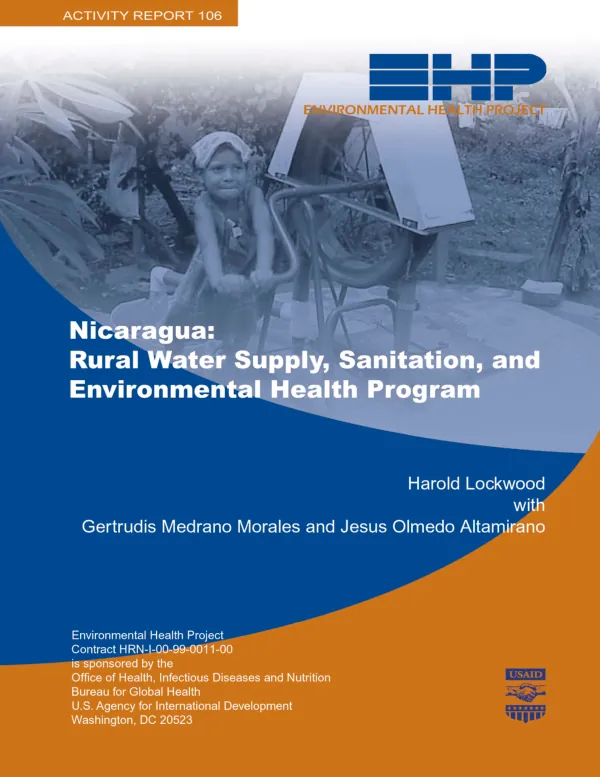
It is organized into the following topical sections: (1) sanitation policy and reform; (2) sanitation strategic frameworks; (3) sanitation interventions -- behavioral, community-based, social marketing, and technological; (4) environmental health studies; (5) integration of sanitation into other health programs; (6) financing for sanitation; (7) sanitation and public-private partnerships; (8) sanitation and capacity building; (9) sanitation in urban populations; and (10) links to additional WASH project resources. Many of these documents were produced under two USAID flagship projects in water supply, sanitation and hygiene: the Environmental Health Project (EHP) and the Hygiene Improvement Project (HIP). The Water and Sanitation for Health (WASH) Project, implemented from 1981 to 1994, was designed to provide technical guidance in the field of sanitation and hygiene. As one of the main players in the USG response to the International Water Decade initiated by the United Nations in 1980, the WASH Project focused on technological interventions, as well as community-based approaches and behavior change activities. The majority of USAID"s programming in water, sanitation, and hygiene has been implemented in the Latin America and the Caribbean region (e.g., El Salvador, Nicaragua, Dominican Republic), with some activities in parts of Africa (e.g., Ethiopia, DRC) and Asia (e.g., India, Indonesia). This resource is a focused set of best practices, lessons learned, and evaluation reports from USAID"s global experiences in water, sanitation, and hygiene. (Author abstract, modified)