U.S. DEPT. OF THE INTERIOR
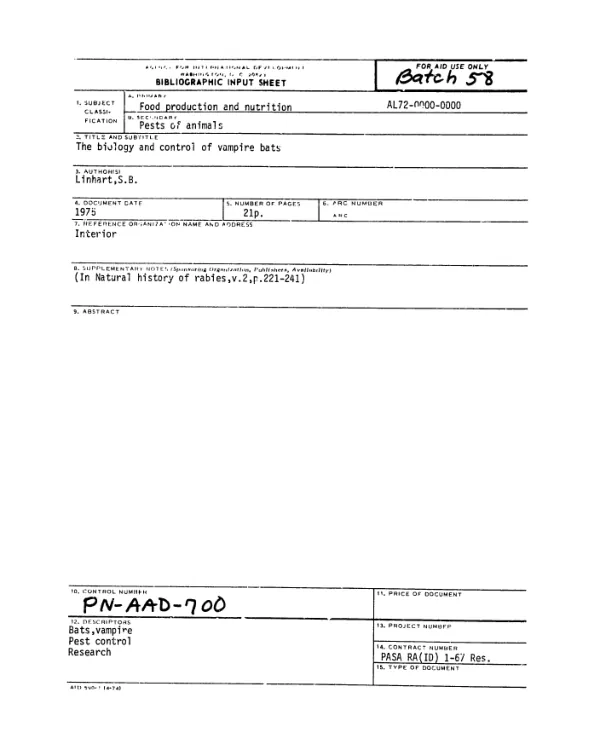
Biology and control of vampire bats
Summarizes the natural history of the vampire bat and its role as a rabies transmittor and economic pest.
Linhart, S. B. · 1970
Sign in to readA free account is required to download.
Abstract
Former vampire bat control methods and recent control efforts of the Denver Wildlife Research Center are also presented. The article begins by discussing the range, density, and general characteristics of vampire bat populations, and details the effect of vampire bat predation on cattle in South America. Relatively unsuccessful past vampire bat control measures using explosives, fumigation, poisoning, vaccination, and mist nets are reviewed. The report next describes preliminary research and field tests conducted in 1978 at the Denver Wildlife Research Center on the use of anticoagulants such as dipehenadione to control vampire bats in Mexico. Two highly successful strategies were developed. In one, an anticoagulant is topically applied to captured bats who then return to their colony, where other bats ingest the anticoagulant during grooming. In the alternative method, cattle are injected with diphenadione, which is subsequently injested by the bats. Both methods are deemed safe and target-selective.
Connected topics