NORTH CAROLINA STATE UNIVERSITY. DEPT. OF PLANT PATHOLOGY
Biology, identification and control of root-knot nematodes (Meloidogyne species)
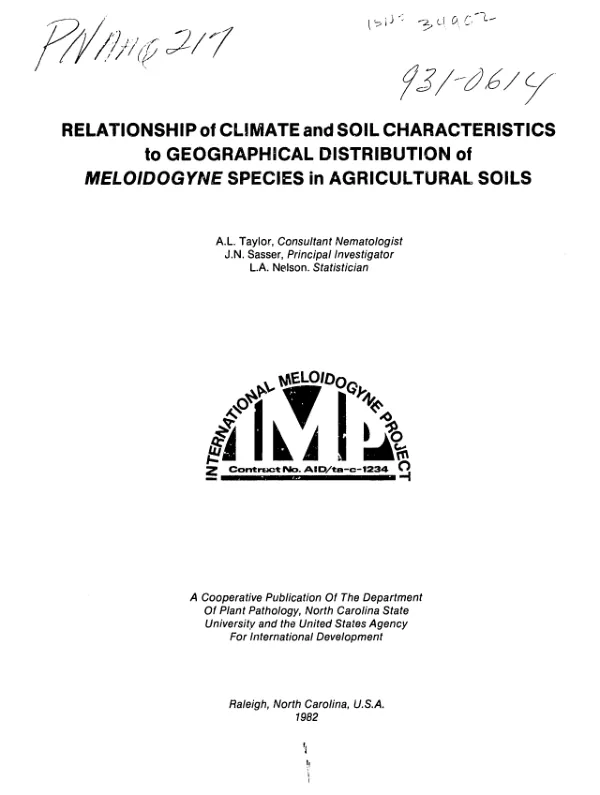
Contributing to the goals of the International Meloidogyne Project, this report assesses the relative importance of various Meloidogyne species (root-knot nematodes) and provides information on their identification, morphology, variability, cytogenetics, geographic distribution, effects on host plants, and control.
Taylor, A. L.; Sasser, J. N. · 1970
Sign in to readA free account is required to download.
Abstract
The report presents: (1) a description of the classification, taxonomy, and worldwide distribution of the Meloidogyne species; (2) a summary of the organism"s life cycle (as affected by time, temperature, and moisture), morphology, reproduction, anatomy, and its relationship to the host plant; (3) a review of the organism"s histology and pathogenesis, with emphasis on giant cells and gall formation; (4) the physical and physiological effects of Meloidogyne infection on plant growth and the affected plant"s subsequent predisposition toward fungal and bacterial infection; (5) the physiological differences among various Meloidogyne species; (6) the ecology of the Meloidogyne species; (7) methods of breeding plant cultivars for resistance to Meloidogyne species; (8) identification and description of Meloidogyne species in both warm and cold climates; (9) integrated control measures (e.g., crop rotation), biological control, quarantine, and use of electricity; and (10) the application, economics, and effects of using nematicides. The report includes numerous photographs and diagrams. Appended are a 231-item bibliography (1878-1977) and short descriptions of the North Carolina Differential Host Test for identifying Meloidogyne, obtaining eggs, and testing plants.