USAID DEC
Bitter Cassava for a Sweet Milk: Bulletin n° 9, November 2019
The agricultural development initiative in Colombia focuses on strengthening competitiveness in cassava production.
2019 · 1 pages
Sign in to readA free account is required to download.
Abstract
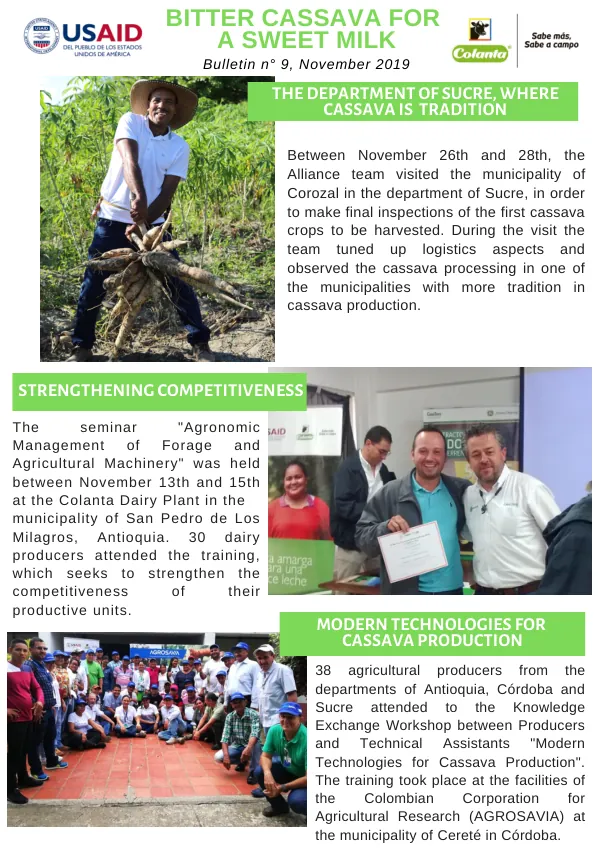
The department of Sucre is a key region for cassava production, with a long tradition of cultivating the crop. In November 2019, the Alliance team conducted a visit to the municipality of Corozal in Sucre to inspect the first cassava crops to be harvested. During the visit, the team reviewed logistics and observed cassava processing in a municipality with a strong cassava production tradition. Agronomic management of forage and agricultural machinery was the focus of a seminar held at the Colanta Dairy Plant in San Pedro de Los Milagros, Antioquia. Thirty dairy producers attended the training, which aimed to enhance the competitiveness of their productive units. The seminar was part of a broader effort to promote modern technologies in cassava production. A knowledge exchange workshop was also conducted, bringing together 38 agricultural producers from Antioquia, Córdoba, and Sucre. The workshop took place at the facilities of AGROSAVIA in Cereté, Córdoba. The cassava production process involves several key stages, including crop management, harvesting, and processing. Modern technologies are being introduced to improve efficiency and productivity in these stages. The use of modern technologies is expected to enhance the competitiveness of cassava producers in Colombia. The initiative also aims to promote knowledge sharing and exchange among producers and technical assistants. In Sucre, cassava is a staple crop, and the department has a long history of cultivating the crop. The region's farmers have developed traditional practices for growing and processing cassava. However, the introduction of modern technologies is expected to improve yields and quality, making cassava production more competitive in the market. The initiative is part of a broader effort to promote agricultural development in Colombia. The implementation of modern technologies in cassava production is expected to have a positive impact on the livelihoods of farmers in Sucre and other regions. Improved yields and quality will enable farmers to increase their income and improve their food security. The initiative also aims to promote sustainable agricultural practices, reducing the environmental impact of cassava production. By strengthening competitiveness in cassava production, the initiative is expected to contribute to the overall development of the agricultural sector in Colombia.