USAID. MISSION TO BOLIVIA
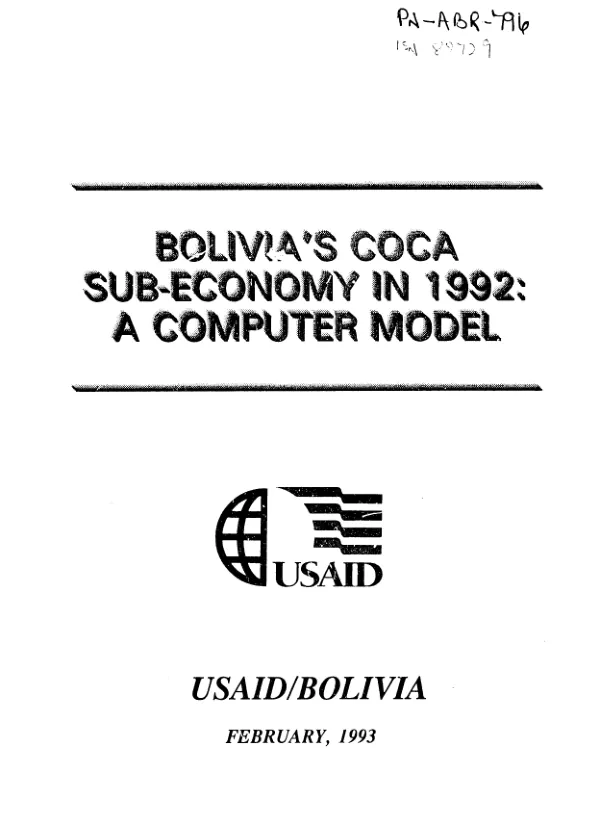
Boliva"s coca sub-economy in 1992 : a computer model
A computer model is presented for estimating the economic impact of coca and coca derivatives in the Bolivian economy.
1993
Sign in to readA free account is required to download.
Abstract
The model calculates production, exports, value added, and employment in the coca sub-economy and interrelates all variables through formulas for automatic calculation via a "control variables table" and other tables which contain production costs at all stages of the coca industry. Since there is a paucity of reliable data for the coca sub-economy, the model makes quite a few assumptions. For the most part, therefore, the model estimates ranges. Still, it does provide a picture of the importance and impact of the coca sub-economy on the Bolivian economy. The estimates show that total direct value added of the coca sub-economy declined from $425 million, representing 8.1% of GDP, in 1988, to $199 million, or 3.1% of GDP, in 1992. Similarly, the amount retained in country is estimated to have declined from $279 million, or 5.3% of GDP, to $97 million, about 1.5% of GDP, during the same period. The export value followed similar trend, declining from $454 million in 1988, representing about 84% of merchandise exports, to $232 million in 1992, or about 38% of exports. These declining trends are believed to be the result of (1) declining prices of coca leaf and the other coca derivatives, and (2) more effective interdiction. Finally, it is estimated that while farm income derived from labor and profit was about $63 million in 1992, the four family clans of narcotraffickers believed to have been operating during 1992 may have earned some $110 million in profit alone. The first section of the report contains a summary of results. The second section outlines the data assumptions and is followed by the "control variables table" in section three. The fourth section presents the entire model with its appendix. The last section presents a few graphs that show the relative importance of the coca sub-economy in Bolivia and the world. Apart from a brief introduction, the report consists virtually entirely of statistical tables and graphs. (Author abstract, modified)
![Structural adjustment, growth and poverty in Madagascar : a CGE [computable general equilibrium] analysis](https://covers.devme.ai/gen/77387.webp)