USAID DEC
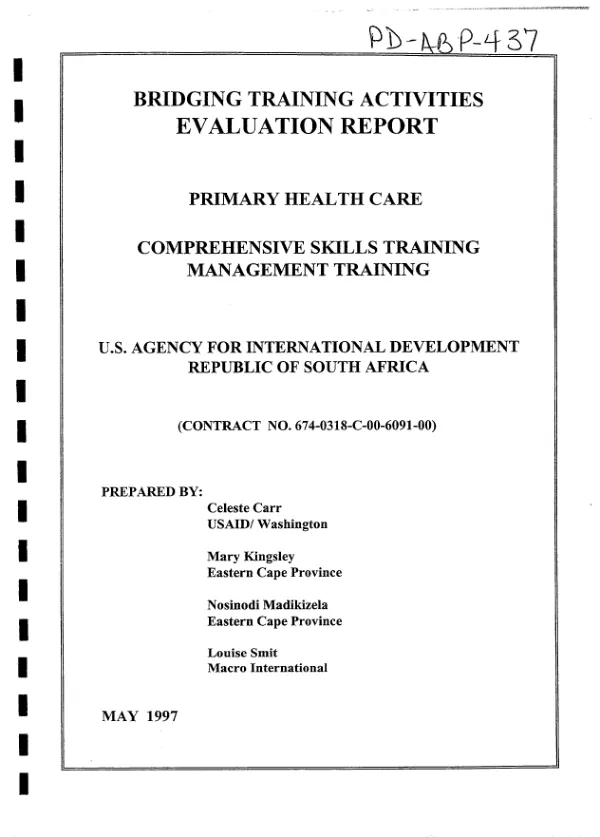
Bridging training activities evaluation report : primary health care -- comprehensive skills training -- management training
Sign inUSAID. MISSION TO SOUTH AFRICA
Bridging training activities evaluation report : primary health care -- comprehensive skills training -- management training
Final evaluation of a program (2/95-2/97) to train health care training, supervisory, and service delivery personnel in primary health care (PHC) skills and management as a means of facilitating implementation of the forthcoming Equity health project (6740320) in South Africa.
Carr, Celeste; Kingsley, Mary · 1997
Sign in to readA free account is required to download.
Abstract
The program has accomplished its objective and set the stage for strengthened and institutionalized PHC training programs within the provinces. Training planning, under the auspices of the Bridging Working Group, joined individuals from diverse parts of the health sector, including teaching institutions, provincial and district government agencies, NGOs, and the private sector, and resulted in the development of a training curricula that has trained PHC personnel as trainers of trainers (TOTs), regional trainers, facilitators, mentors, preceptors, and frontline PHC providers. By-products of this training are the creation of a province-wide training infrastructure essential for the implementation of distance-based learning (DBL), and a cadre of experts on training module development. However, the project was not without implementation problems. These included inconsistent selection of TOTs and mentors, the fact that participants often had to provide there own transportation, the lack of a liaison person at the national level, and a lack of coordination of the training efforts between the Human Resource Development (HRD) and PHC Directorates in the Eastern Cape. Further, the intensity and depth of the training did not allow adequate time for the TOTs to develop and practice their skills as teachers/trainers; further support and supervision is needed as they assume their role as trainers of others within their regions. In many districts, training policies and structures had not yet been established so that newly trained TOTs were not able to practice their new skills. Finally, an accreditation policy for Bridging Training Activities has not yet been developed. Relatedly, the TOTs have not been evaluated on their individual performance, a step necessary in the pursuit of accreditation. Key lessons learned as follows. (1) The successful mechanism of the Bridging Working Group, which forged a strong alliance of individuals from diverse parts of the health sector, should be incorporated into the proposed District Health Training Committees. (2) The training modules, composed of a mix of intensive participatory training in a classroom and on-site training in the clinic, was a valuable methodology that allowed instruction as well as hands on learning and problem solving. (3) The DBL concept, consisting of self-study modules, clinical skill check lists, self-evaluations, and supportive material, was an excellent model that could be used throughout the provinces. Integration of this concept into the comprehensive PHC skills course helped alleviate problems with training capacity between regions and districts. (4) The training courses were practical and community based, which demonstrated to participants the value of community participation.
Related documents
![Ndwedwe District [South Africa] child survival project : cooperative agreement no. FAO-A-00-97-00025-00 -- final evaluation report](https://covers.devme.ai/gen/61395.webp)
![Ndwedwe District [South Africa] child survival project : cooperative agreement no. FAO-A-00-97-00025-00 -- final evaluation report](https://covers.devme.ai/gen/5412.webp)