USAID/OFFICE OF TRANSITION INITIATIVES
Burkina Faso Regional Program BI-WEEKLY REPORT August 15-28, 2020
The USAID/Office of Transition Initiatives' Burkina Faso Regional Program (BFRP) targets strategic communities in the Est, Nord, and Sahel regions to mitigate the destabilizing effects of continued violence and insecurity.
2020 · 1 pages
Sign in to readA free account is required to download.
Abstract
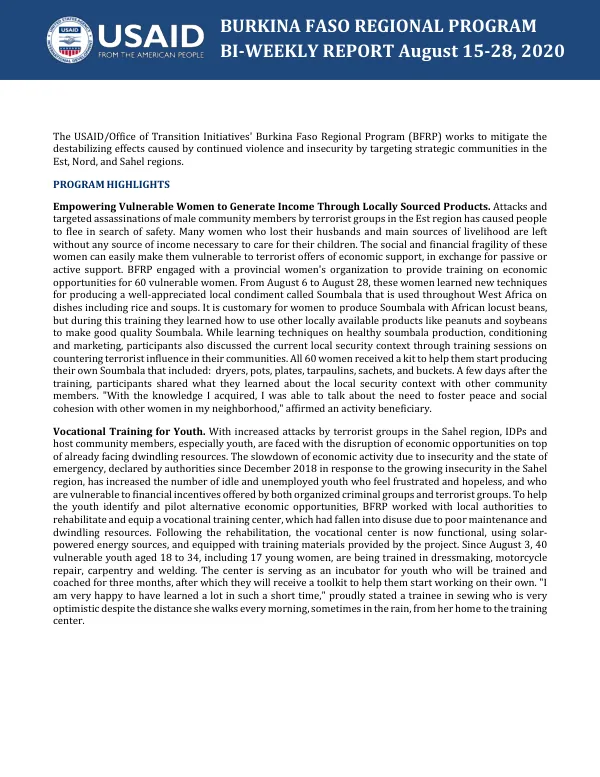
Empowering vulnerable women to generate income through locally sourced products is a key component of the program. In the Est region, attacks and targeted assassinations by terrorist groups have caused people to flee in search of safety, leaving many women without a source of income to care for their children. BFRP engaged with a provincial women's organization to provide training on economic opportunities for 60 vulnerable women. From August 6 to August 28, these women learned new techniques for producing Soumbala, a well-appreciated local condiment used throughout West Africa. The training included learning how to use locally available products like peanuts and soybeans to make good quality Soumbala, in addition to techniques on healthy Soumbala production, conditioning, and marketing. Participants also discussed the current local security context through training sessions on countering terrorist influence in their communities. All 60 women received a kit to help them start producing their own Soumbala, which included dryers, pots, plates, tarpaulins, sachets, and buckets. A few days after the training, participants shared what they learned about the local security context with other community members. This initiative aims to empower women to generate income and reduce their vulnerability to terrorist influence. In the Sahel region, BFRP worked with local authorities to rehabilitate and equip a vocational training center, which had fallen into disuse due to poor maintenance and dwindling resources. The center is now functional, using solar-powered energy sources, and equipped with training materials provided by the project. Since August 3, 40 vulnerable youth aged 18 to 34, including 17 young women, are being trained in dressmaking, motorcycle repair, carpentry, and welding. The center serves as an incubator for youth who will be trained and coached for three months, after which they will receive a toolkit to help them start working on their own. The vocational training program aims to help youth identify and pilot alternative economic opportunities, reducing their vulnerability to financial incentives offered by organized criminal groups and terrorist groups. By providing training and equipment, BFRP seeks to empower youth to become self-sufficient and contribute to the economic development of their communities.