USAID DEC
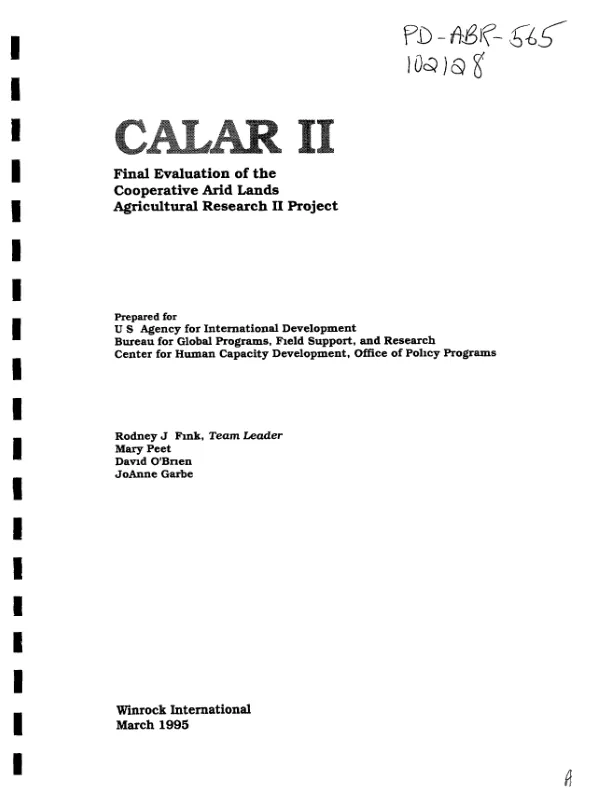
CALAR II : final evaluation of the cooperative arid lands agricultural research II project
Sign inSAN DIEGO STATE UNIVERSITY FOUNDATION
CALAR II : final evaluation of the cooperative arid lands agricultural research II project
Final evaluation of the Cooperative Arid Lands Agricultural Research II project (CALAR II -- 3/90-3/95), designed to promote peaceful cooperation between Egypt and Israel through multi-disciplinary agricultural research.
Fink, Rodney J.|Peet, Mary · 1995
Sign in to readA free account is required to download.
Abstract
San Diego State University Foundation (SDSUF) served as contractor, with major subgrants to the Ministry of Agriculture and Land Reclamation (Egypt) and to Ben-Gurion University of the Negev (Israel). CALAR II is part of the Middle East Regional Cooperation (MERC) program. The project enhanced the expansion and implementation of protected agriculture in Egypt and Israel while enabling scientists of the two countries to cooperate in their work. Technical objectives were met regarding the introduction and genetic modification of new crops, agro-management, environmental modification, and structure selection. Though work on post-harvest technical objectives was minimal, both countries have qualified post-harvest physiologists in close contact with experts from other countries. SDSUF managed the program effectively, taking a direct, hands-on interest in the project, much more than required and expected of a project contractor. The country coordinators and the steering committee were also effective, though a smaller one is recommended. Project-supported annual workshops enhanced cooperation and information transfer between Israeli, Egyptian, and the participating U.S. scientists who played a major role in helping the program succeed. The final presentations of scientists will be part of a 3/95 International Society of Horticultural Science meeting in Alexandria, Egypt. This meeting was organized by one of the Egyptian participants and will provide an international forum for project results. CALAR II was successful in expanding scientific cooperation among between Egypt, Israel, and the United States through country visits and the annual workshops. On a negative note, research took place in parallel projects, structured according to country priorities, with minimal one-to-one collaboration between scientists. Neither project design nor project management encouraged or rewarded truly collaborative research; hence, none occurred, even though scientists interviewed indicated a desire for it. In addition, since CALAR I began in FY 82, only one joint research publication between an Israeli and Egyptian scientist has appeared. The momentum gained in improving cooperation and understanding between Israeli and Egyptian scientists through CALAR II should be sustained through follow-on activities. Otherwise, ongoing contact between Egyptian and Israeli scientists will be minimal. Research sites in both countries will be maintained following CALAR II, but research in Egypt will continue at a reduced level. The following lessons were learned: (1) Future projects should be specific about output targets. (2) Whenever possible, future projects should have reciprocal exchanges of scientists and personnel from both countries. (3) The support of the USAID Mission and the U.S. Embassy enhances the success of MERC projects, which should, when possible, complement Mission priorities. Onsite monitoring by MERC personnel should help projects meet goals and objectives. (4) Contractors should be clearly identified as facilitators for evaluation teams. (5) Future projects should carefully evaluate the amount of travel outside the target countries and the size and role of advisory groups (such as the technical and steering committees). (6) Project activity between Egyptian and Israeli scientists must be an association among equals throughout the process of planning, implementation, and dissemination of results. (7) Project funds should be devoted to the maximum extent possible to collaborative research in Egypt and Israel.
Related documents
![Maryut II grant HNE-0158-G-2069-00 [i.e. HNE-0158-G-00-2069-00] : annual technical report October 1, 1994 - September 30, 1995](https://covers.devme.ai/gen/83976.webp)