USAID DEC
Cameroon : project assistance completion report -- tropical roots and tubers research project
Sign inUSAID. MISSION TO CAMEROON
Cameroon : project assistance completion report -- tropical roots and tubers research project
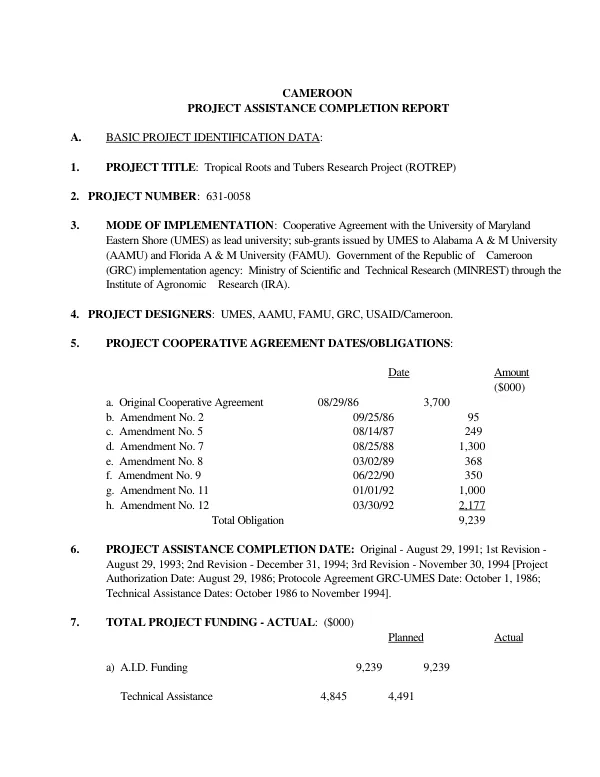
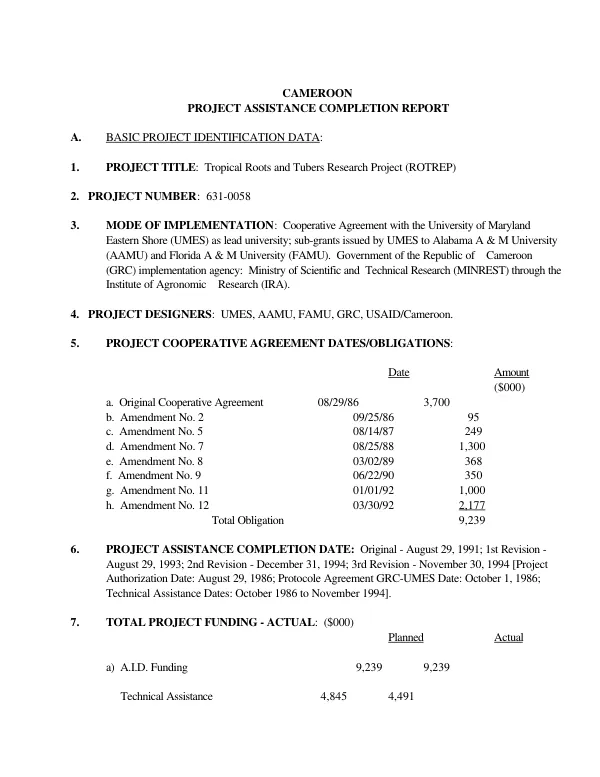
PACR of a project (8/86-11/94) to conduct tropical root and tuber crop research in Cameroon aimed at developing (1) locally acceptable cocoyam varieties resistant to root rot disease, and (2) technically and economically feasible seedstock multiplication systems for yam, cassava, and cocoyam (ROTREP project).
Sign in to readA free account is required to download.
Abstract
The University of Maryland Eastern Shore implemented the project with assistance from Alabama A&M University and Florida A&M University. ROTREP is succeeding in fulfilling its objectives. Although a cocoyam variety resistant to root rot disease was not developed by the 11/94 PACD, production of cassava and cocoyams (the main root and tuber crops) increased, in part, because of the release of improved cultivars (at least 15 clones of root and tuber crops were released to growers) and because of recommended cultural techniques. Standard cultural practices for growing root and tuber crops were transferred to farmers in the form of technical bulletins, mini-kit packages, and field-level demonstrations. The total value of root and tuber crops increased, estimated at 856% annually for potatoes and 360% for cocoyams. Adoption of new material generally increased farmers' sales by 31% for cassava and 43% for sweet potatoes. Total consumption has increased by almost 6% for cassava and 37% for sweet potatoes. The development of feasible seedstock multiplication systems for cassava, cocoyams, and yams is almost complete. In terms of institutional development, the training of Cameroonian researchers will lead to Cameroon's root and tuber research program being managed predominantly by Cameroonians. ROTREP trained a large cadre of researchers (7 at the graduate level, 12 via short-term, third-country training, and more than 100 via in-country training), and developed the J.P. Johnson Biotechnology Laboratory, a center of excellence which can be used to develop new technologies, and roots, tubers, and other crops. Long-term linkages have been established with many research institutions (e.g., IITA, CIP, as well as the three project universities). The following lessons were learned. (1) Sustainable development in Cameroon and other African countries will require increased use of profitable and sustainable technologies to help farmers, processors, marketing agents, and policy makers address on- and off-farm constraints and to accelerate transformation. (2) The flow of technology to and within Africa to meet future needs will require an enabling environment in terms of research and policy institutions, financially sustainable funding mechanisms, and human resource capacity. (3) Successful institutional development is a long-term endeavor which requires a comprehensive approach, high-level commitment by all parties, flexibility, patience, and willingness and ability to adjust to changing conditions. This project reflected many, but not all of these attributes. USAID's investment has created a large cadre of trained researchers who have returned to weak institutions in which they are unable to fully realize their potentials. The project may have not been integrated within the Institution for Agronomic Research (IRA) to the extent desirable. As a result, many of the management improvements have not been fully institutionalized. In addition, the decision to cover nearly all of the IRA's operational costs after the Government of Cameroon (GRC) greatly reduced its budgetary contribution was inappropriate; conditionality should have been negotiated with the GRC to ensure long-term institutional reform and financial viability. The project also failed adequately to address broader institutional issues such as priority setting, downsizing, diversification of funding, and resource accountability. USAID missed a unique opportunity to use both the project, as well as the National Cereals Research and Extension Project, to achieve these ends. (4) The project demonstrated the benefit of networking and linkages; "intelligent borrowing" helped reduce plant breeding periods and corresponding costs. (5) Recognizing the important role that both the IRA and the University of Dschang could play in regional development, USAID collaborated closely with the GRC and other donors in creating "research and educational centers of excellence." Unfortunately, the comprehensive approach required for long-range institutional development and sustainability did not take this regional role adequately into account. The institutional crisis currently facing Cameroon's agricultural sector, including both the IRA and the University of Dschang, unless addressed soon, could have serious implications for neighboring countries. (6) Donor coordination for the most part focused on subsector issues (agricultural research, environment) and failed to address broader sectoral and macroeconomic issues (although the World Bank has been meeting with other donors to design an agricultural sector structural adjustment program).