TEARFUND INTERNATIONAL
CAR AID-OFDA-G-15-00275 Quarterly Program Performance Report
The agricultural development initiative in the Central African Republic began in September 2015 with funding from USAID's Food Security Program.
2016 · 11 pages
Sign in to readA free account is required to download.
Abstract
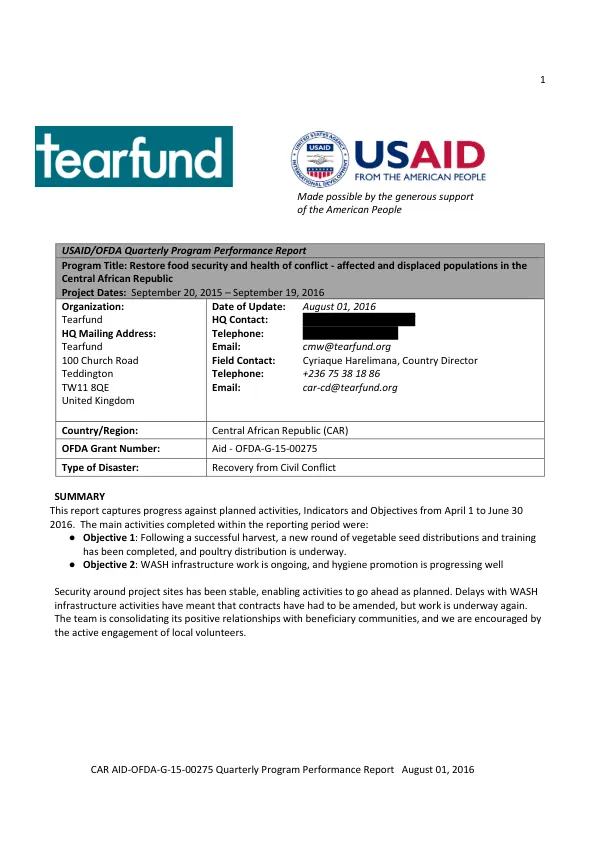
The project, implemented by Tearfund, aimed to restore food security and health of conflict-affected and displaced populations in the region. Initial assessments identified soil degradation and limited market access as primary challenges. Implementation focused on two key sectors: agriculture and food security, and livestock. In the agriculture and food security sector, targeted beneficiary households received crop and vegetable seeds, tools, and training on sustainable agriculture techniques. More than 2,500 households participated in training, with a focus on nutritional diversity and techniques of farming. Beneficiaries also received training on cross-cutting issues, including humanitarian accountability principles. In the livestock sector, livestock distribution to 500 households was underway, with 41 households receiving chickens. The project team encountered an issue with the poultry supplier, which delayed the distribution of chicks. To address this issue, the team proposed reducing the number of chicks per household from four to two. The project reported several successes, including the formation of agricultural associations, which provided peer support and facilitated further distributions and training. Beneficiaries also showed high adoption rates for sustainable agriculture practices, with women-headed households demonstrating higher adoption rates. The project team noted that Muslim households, who were previously not involved in vegetable gardening, were particularly active participants in training and showed better crop performance. The project also reported on the impact of its activities, with indicators showing progress towards the target of increasing the number of months of food self-sufficiency for beneficiary households. The project reported an increase of 0.6 months, with a target of four months. The number of people benefiting from seed systems and agricultural input activities also increased, with a total of 14,708 people benefiting from the project. The project team also reported on the success story of Youssou, a beneficiary who had previously kept and farmed chickens, but was forced to flee during the conflict. With the support of the project, Youssou and his family were able to grow food on the land opposite their home and start rebuilding their chicken business. The project's progress was reported in the quarterly program performance report, which captured progress against planned activities, indicators, and objectives from April 1 to June 30, 2016. The report highlighted the project's achievements, challenges, and proposed alterations to activities.