USAID DEC
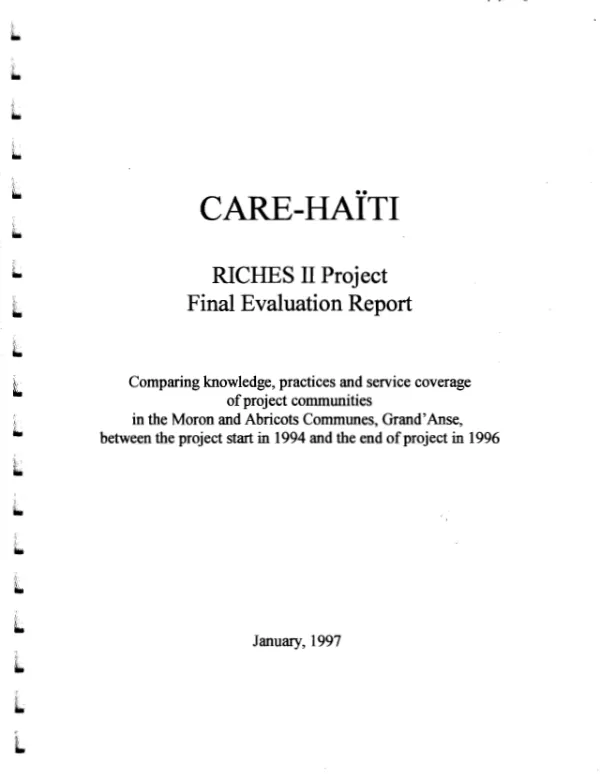
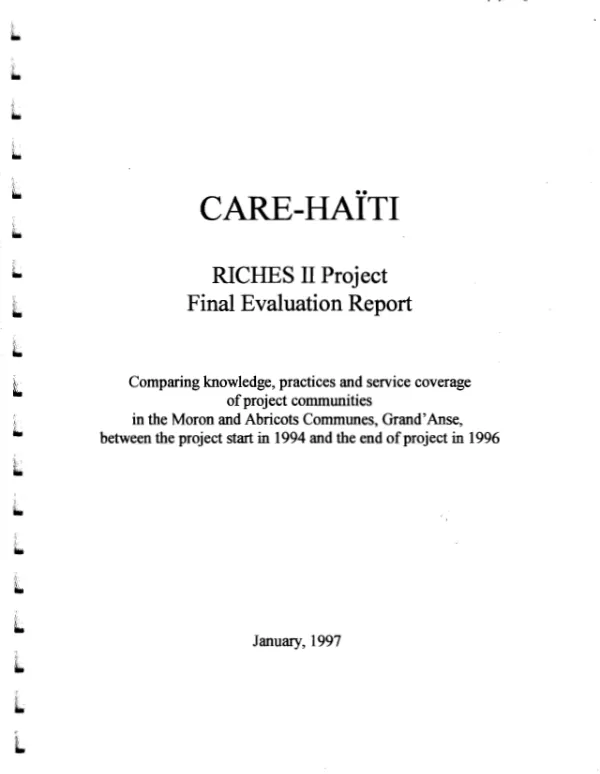
CARE-Haiti : RICHES II project -- final evaluation report : comparing knowledge, practices and service coverage of project communities in the Moron and Abricots communes, Grand"Anse, between the project start in 1994 and the end of project in 1996
Sign inCARE INTERNATIONAL
CARE-Haiti : RICHES II project -- final evaluation report : comparing knowledge, practices and service coverage of project communities in the Moron and Abricots communes, Grand"Anse, between the project start in 1994 and the end of project in 1996
Final evaluation of the knowledge, practices, and service coverage of the Resources in Community Health Education Support (RICHES) II project in its target population -- the Moron and Abricots communes, Grand"Anse, Haiti.
1997
Sign in to readA free account is required to download.
Abstract
The evaluation covers 1994 and 1996 surveys of 423 mothers with a child aged 0-24 months. The project was highly successful in terms of coverage, with 74% of the target population surveyed reporting having attended a RICHES rally post in the 3 months prior to the survey. Generally, the survey revealed that the project performed satisfactorily when measured in terms of USAID performance indicators in the areas of infant and child nutrition, diarrhea management, acute respiratory infection recognition, vaccinations for children and women, prenatal care and preparation for child birth, family planning, malaria prevention, and AIDS prevention. Specific findings were as follows: The prevalence of exclusive breastfeeding for children aged 0-4 months increased from 19% to 74%, and levels of mothers" knowledge and their practices in terms of child nutrition are satisfactory, with mothers introducing weaning foods later and feeding their young children a greater variety of foods, including more protein-rich foods. According to Road-to-Health cards, the prevalence of vitamin A distribution is approximately 60%. There is no change in knowledge of the frequency of meals given to young children between 1994 and 1995: the majority of mothers stated that they should feed their children two or three times per day. Management of childhood diarrhea also improved, even though the prevalence of diarrhea in the index child in the last 2 weeks remained unchanged (40% in 1996). All respondents reported using oral rehydration therapy. More mothers in 1996 also continued or increased breastfeeding (97% in 1996 versus 83% in 1994) and giving foods (92% versus 72%) and liquids (93% versus 62%) to the sick child. Knowledge of signs of acute respiratory infections and taking children with respiratory distress for treatment also improved. However, the reported prevalence of children showing flu-like symptoms in the past 2 weeks remained high at 62% in 1996. Vaccination coverage improved a great deal but did not reach the expected 60% coverage level. Only 26% of women received the second dose of tetanus toxoid and only 44% of children received a measles vaccination. Results were more mixed for pre-natal care and delivery preparation practices. During their last pregnancy, more women in 1996 made a pre-natal visit to a health care provider (87% versus 62% in 1994). Knowledge of foods good to eat during pregnancy increased, but the idea of eating more during pregnancy was cited by only 51% of the respondents. Also, knowledge of what to prepare for childbirth (assembling safe birth kits) was uneven. Respondents" knowledge levels of contraceptive methods is high, a large increase since 1994. The contraceptive prevalence rate (CPR) is estimated at 22%, up from 6% in 1994. The preferred method is the oral contraceptive pill at 10%. Despite the project emphasis on sexually transmitted diseases (STDs) and AIDS, the prevalence of condom use is only 5% but this is very good when compared to national rates for condom use. The means of malaria transmission and of prevention are poorly understood in all the study communities. There is no change in knowledge level between the baseline and final study. Sixty-nine percent of the respondents did not know how malaria was transmitted, and fully 75% did not know how to prevent the disease. Regarding knowledge of AIDS, and the ability to cite AIDS as a disease spread through sexual relations, respondents are well informed. In fact, nearly 99% of respondents affirmed their knowledge of AIDS, as opposed to 83% in 1994. A vast majority of respondents cite sexual promiscuity as a main form of AIDS transmission. Unfortunately, AIDS transmission through the use of dirty syringes was cited by only 15% of respondents. The means of AIDS prevention most cited was fidelity (97%), followed by the use of condoms (94%).
Related documents
Documents in this collection
 1996
1996USAID DEC
CARE-Haiti : RICHES II project -- final evaluation report : comparing knowledge, practices and service coverage of project communities in the Moron and Abricots communes, Grand'Anse, between the project start in 1994 and the end of project in 1996
Open record![Midterm evaluation for the period of November 1994 - August 1996 -- final report : child survival activities in Haiti -- integration of sustainable child survival interventions into the mission of CRUDEM [Center for Rural Development of Milot], a private sector organization in the Department of the North, Haiti](https://covers.devme.ai/gen/6090.webp) 1996
1996USAID DEC
![Midterm evaluation for the period of November 1994 - August 1996 -- final report : child survival activities in Haiti -- integration of sustainable child survival interventions into the mission of CRUDEM [Center for Rural Development of Milot], a private sector organization in the Department of the North, Haiti](https://covers.devme.ai/gen/65690.webp)
![Final evaluation report for the period of November 1994-August 1997 : child survival activities in Haiti -- integration of sustainable child survival interventions into the mission of CRUDEM [Center for Rural Development of Milot], a private sector organization, in the Department of the North, Haiti](https://covers.devme.ai/gen/53374.webp)