USAID DEC
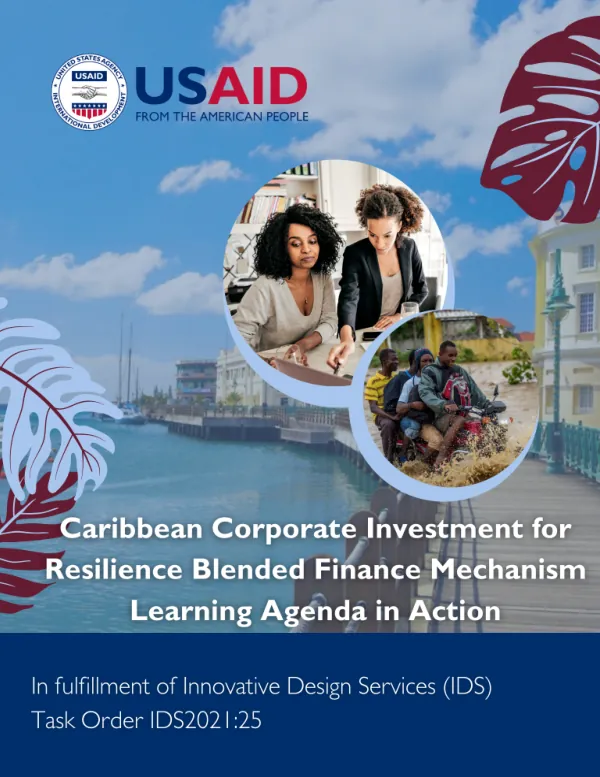
Caribbean Corporate Investment for Resilience Blended Finance Mechanism Learning Agenda in Action
Sign inBANK FOR WEST AFRICAN DEVELOPMENT
Caribbean Corporate Investment for Resilience Blended Finance Mechanism Learning Agenda in Action
The Caribbean Corporate Investment for Resilience Blended Finance Mechanism (CCIR BFM) was launched by USAID's Bureau for Humanitarian Assistance (BHA) to support businesses in the Eastern Caribbean in enhancing disaster resilience.
34 pages
Sign in to readA free account is required to download.
Abstract
The Mechanism aims to use blended finance to increase disaster resilience in the region by supporting businesses and initiatives with sound economic models. The CCIR BFM Activity used blended finance by combining catalytic funding from USAID BHA with private capital sources to de-risk investments and scale. This approach represented a pioneering effort by BHA to kick-start resilience investments, engage the private sector, and create a lasting impact. The Mechanism consisted of three core activities: building an investment fund of potential awardees, designing the mechanism to de-risk funds for outside investment, and managing USAID de-risking funds to support greater private sector investment. The CCIR BFM's theory of change is based on the idea that utilizing blended finance can de-risk investments and promote sustainability in targeted economies in the Eastern Caribbean. By attracting more private capital to resilient investments, the CCIR BFM aims to build a more resilient private sector, promote economic recovery, and enhance communities' capacity to respond to and recover from disasters. The Mechanism's outcomes have been successful, with the CCIR BFM funding six organizations to enhance their disaster resilience. These organizations include HD Caribbean, a renewable energy innovation company, and Iyanola Apiculture, a civil society organization that promotes beekeeping in Saint Lucia. The CCIR BFM has also provided grant-funded technical assistance to awardees to enhance their ability to scale their operations and projects. The CCIR BFM's approach to blended finance has been effective in de-risking investments and promoting private sector engagement. The Mechanism has also provided valuable insights into the use of blended finance in driving resilience and economic growth. The CCIR BFM's outcomes and learnings will serve as a blueprint for USAID BHA to employ blended finance approaches in other regions. The CCIR BFM's success has been due to its adaptive management approach, which allowed the team to test approaches, test approaches based on stakeholder feedback, and deploy innovative ideas and approaches as they learn. This approach has enabled the CCIR BFM to build a strong foundation for future blended finance initiatives. The CCIR BFM's outcomes have also been influenced by its institutional relevance. The Mechanism has been designed to capture and highlight the learnings of various stakeholders and implementation partners, and to connect USAID BHA's larger goal of mobilizing investment capital and increasing private sector engagement to further development outcomes. The CCIR BFM's theory of change posits that the use of blended finance will: * Mobilize commercial debt and/or equity through grants, technical assistance, and concessional capital * Lower the costs of funding, increase available capital, and de-risk investments by aggregating domestic and foreign resources * Create long-term cost-effective solutions within economic sectors * Increase private capital to flow towards investments in economic resilience * Promote broader economic recovery and equip communities to recover from disasters more rapidly and effectively * Enable additionality, i.e., the opportunity to achieve goals that would not have happened without donor intervention The CCIR BFM's outcomes have been successful in achieving these goals, with the Mechanism having a positive impact on the private sector, communities, and communities' capacity to respond to and recover from disasters. The CCIR BFM's success has also been due to its focus on supporting small to medium-sized enterprises (SMEs), which are critical to the growth and development of the private sector in the Eastern Caribbean. The Mechanism has provided valuable insights into the challenges faced by SMEs in accessing finance and has developed innovative solutions to address these challenges. The CCIR BFM's outcomes have also been influenced by its focus on promoting economic recovery and resilience in the Eastern Caribbean. The Mechanism has provided valuable insights into the challenges faced by the region in recovering from disasters and has developed innovative solutions to address these challenges. The CCIR BFM's success has also been due to its focus on promoting private sector engagement and mobilizing private capital to support resilience investments. The Mechanism has provided valuable insights into the challenges faced by the private sector in accessing finance and has developed innovative solutions to address these challenges. The CCIR BFM's outcomes have also been influenced by its focus on promoting economic growth and development in the Eastern Caribbean. The Mechanism has provided valuable insights into the challenges faced by the region in promoting economic growth and development and has developed innovative solutions to address these challenges. The CCIR BFM's success has also been due to its focus on promoting resilience and economic growth in the Eastern Caribbean. The Mechanism has provided valuable insights into the challenges faced by the region in promoting resilience and economic growth and has developed innovative solutions to address these challenges. The CCIR BFM's outcomes have also been influenced by its focus on promoting private sector engagement and mobilizing private capital to support resilience investments. The Mechanism has provided valuable insights into the challenges faced by the private sector