USAID. BUR. FOR LATIN AMERICA AND THE CARIBBEAN. REGIONAL DEVELOPMENT OFC.
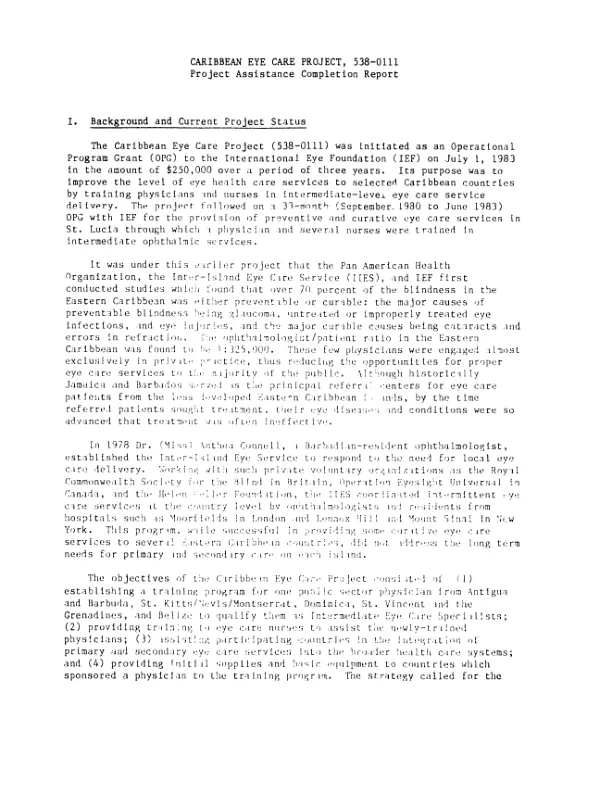
Caribbean eye care project, 538-0111 : project assistance completion report
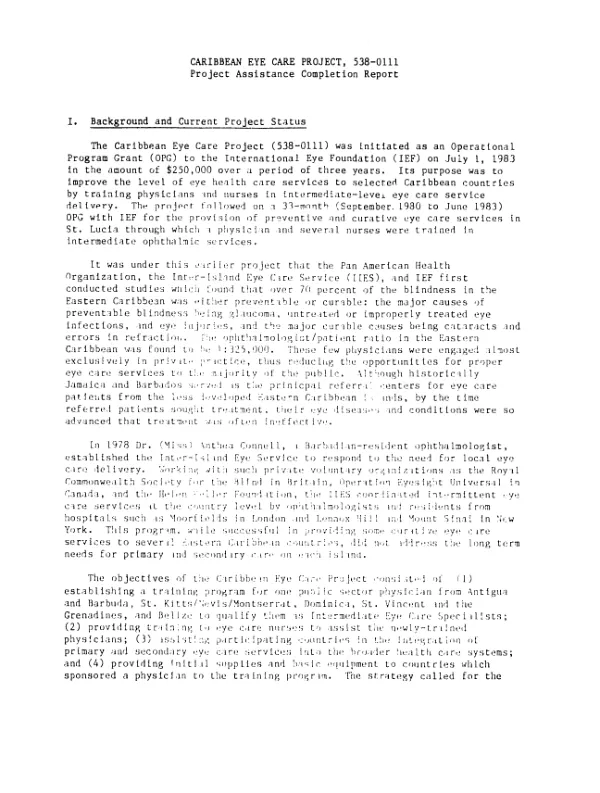
Project assistance completion report on a project (7/83-9/87) to improve the level of eye care in selected Caribbean countries by training physicians and nurses in intermediate-level eye care.
Sign in to readA free account is required to download.
Abstract
The project achieved some of its objectives; yet, some targets were not reached and others will require more time to assess. A regional training program was set up through the University of the West Indies which should, since it is designed and taught by West Indian personnel, be relevant to eye care problems prevalent in the region. This program has trained three project-funded and five externally funded physicians. Nurses' training by the International Eye Foundation (IEF) and a project-trained physician has already resulted in the introduction of glaucoma screening programs and public education campaigns on preventable eye disease and injuries. A standardized nurses' training curriculum has been set and teaching materials have been distributed to all of the project countries for use by trained nurse educators. An indisputable success of the project has been its ability to leverage and coordinate greater donor assistance to maximize impact. In fact, the project hosted the first Caribbean Eye Care Seminar for the Prevention of Blindness in Barbados in 12/83. A similar meeting, with participation by A.I.D., has been held annually since, culminating in 1986 in the formal establishment of an Inter-Agency Committee for Eye Care in the Caribbean. The overall impact of the physicians' training program, however, receives a mixed score. Of the three project-supported trainees, one has not been accepted by his peers (because the training was diploma, not degree, level), one left government service prior to completing her in-country practicum, and one transferred out of the program. Of the five physicians supported by external funding, four have used the program as the first step towards advanced training in ophthalmology. Thus, while six of the physicians completed the course and passed the University of London DO exams (which generally have a pass rate of 20% or less), only one of these six was supported by project funds. This indicates that the quality of the program was not at fault and points to three interrelated problems: the candidate selection process; the delays and uncertainties surrounding the certification process; and the intention of the program, i.e., to train only to the diploma level while discouraging advanced training toward an internationally recognized ophthalmology degree (and possible emigration). Lessons learned include: (1) project expectations, and the roles of participating agencies, must be clearly understood and agreed to from the start; (2) training programs must be assessed with regard to the acceptance of the training by local organizations.
![Project assistance completion report : Caribbean and Latin American scholarship program (CLASP) [including LAC training initiatives II and the Presidential training initiative for the island Caribbean]](https://covers.devme.ai/gen/7220.webp)