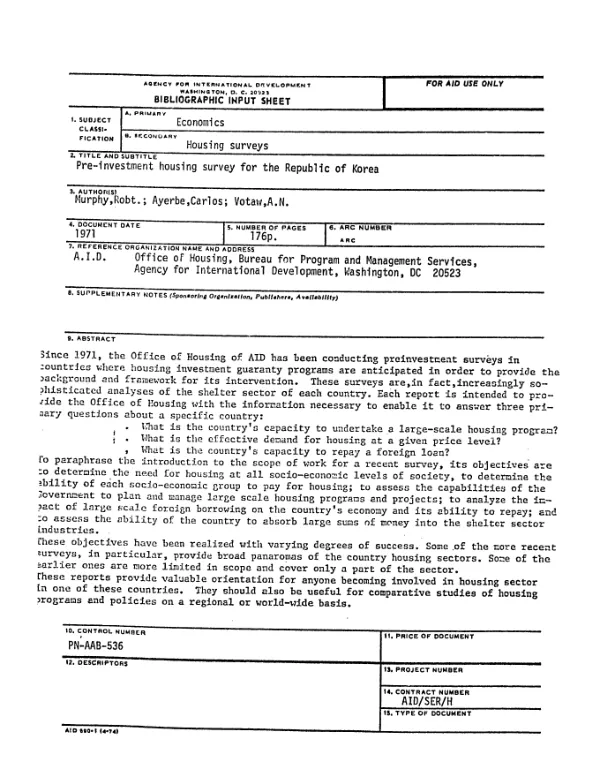
USAID. BUR. FOR PROGRAM AND MANAGEMENT SERVICES. OFC. OF HOUSING
CASE STUDY OF THE KOREAN HOUSING INVESTMENT GUARANTY PROGRAM 1971-1977
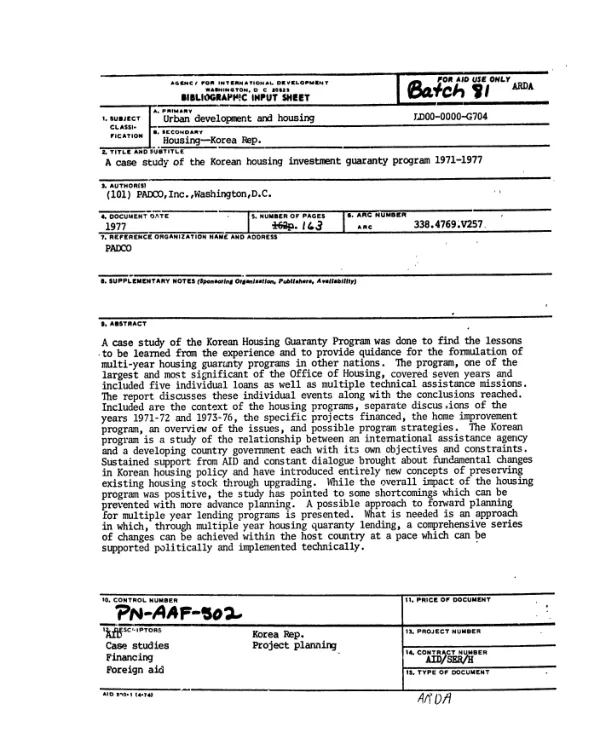
A case study of the Korean Housing Guaranty Program was done to find the lessons to be learned from the experience and to provide guidance for the formulation of multi-year housing guaranty programs in other nations.
1970
Sign in to readA free account is required to download.
Abstract
The program, one of the largest and most significant of the Office of Housing, covered seven years and included five individual loans as well as multiple technical assistance missions. The report discusses these individual events along with the conclusions reached. Included are the context of the housing programs, separate discussions of the years 1971-72 and 1973-76, the specific projects financed, the home improvement program, an overview of the issues, and possible program strategies. The Korean program is a study of the relationship between an international assistance agency and a developing country government each with its own objectives and constraints. Sustained support from AID and constant dialogue brought about fundamental changes in Korean housing policy and have introduced entirely new concepts of preserving existing housing stock through upgrading. While the overall impact of the housing program was positive, the study has pointed to some shortcomings which can be prevented with more advanced planning. A possible approach to forward planning for multiple year lending programs is presented. What is needed is an approach in which, through multiple year housing guaranty lending, a comprehensive series of changes can be achieved within the host country at a pace which can be supported politically and implemented technically.
Connected topics