USAID DEC
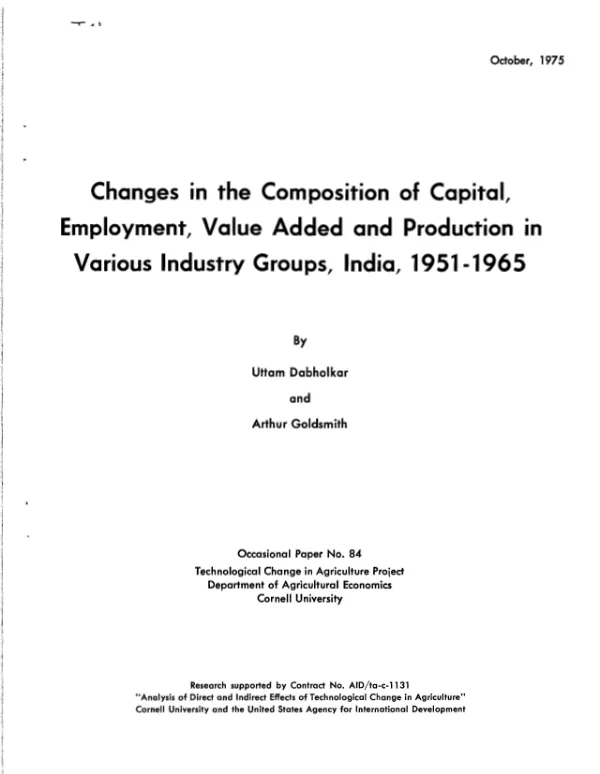
Changes in the composition of capital, employment, value added, and production in various industry groups, India, 1951-1965
Sign inCORNELL UNIVERSITY
Changes in the composition of capital, employment, value added, and production in various industry groups, India, 1951-1965
Recently, social analysts and policymakers have exhibited increased interest in employment-oriented development strategies for the Third World.
Dabholkar, Uttam; Goldsmith, Arthur A. · 1970
Sign in to readA free account is required to download.
Abstract
Past attempts at development have tended to neglect industries using a high labor input, including most consumer goods industries, while favoring investment in capital-intensive industries such as steel and heavy machinery. Because of the recent interest in accelerated employment growth and the development of labor-intensive industries, an examination of the relevant statistics in India is instructive. Tables 1 through 6 of this report present data on employment, capital, and output in registered (large and medium) Indian industries in 1951, 1957, 1961, and 1965. The smaller or unregistered firms, which contribute perhaps one-third of India"s industrial products, are excluded due to lack of data. Following Tables 1 through 6 is a discussion of potential employment levels in the reference years, the causes of net potential job loss, and some of the policy implications of those findings.
Connected topics
Related documents