USAID. BUR. FOR FOOD FOR PEACE AND VOLUNTARY ASSISTANCE. OFC. OF PROGRAM POLICY AND MANAGEMENT
Changing food consumption patterns in sub-Saharan Africa
For the past 25 years, food consumption in sub-Saharan Africa has followed a pattern familiar in the developing world.
Wilde, Parke · 1989
Sign in to readA free account is required to download.
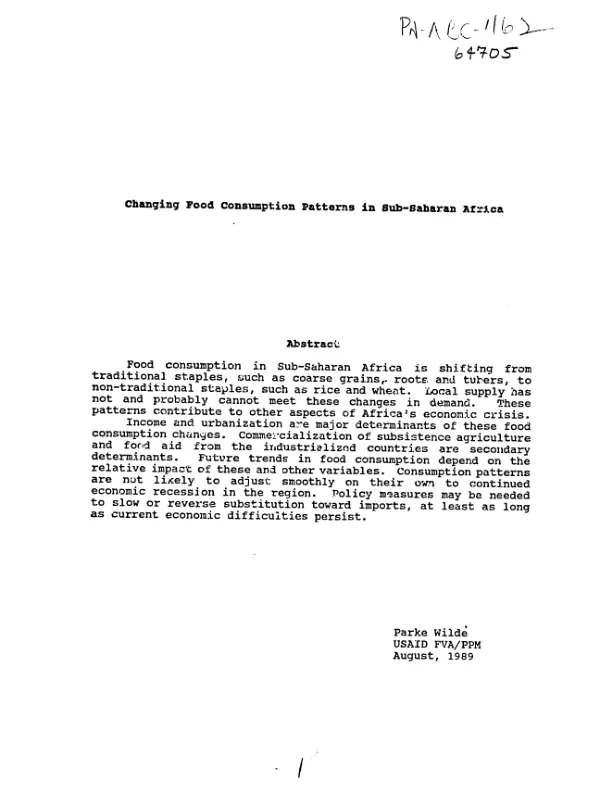
Abstract
Traditional staples (roots, tubers, coarse grains) gave way to preferred staples (rice and wheat), which in turn lost much of their share to meat products. In many countries, such trends are the unsurprising result of normal economic growth, but in the context of sub-Saharan Africa"s economic recession and agricultural decline -- only 14 of 38 sub-Saharan countries were self-sufficient in basic food in 1985 -- they pose a danger to food security. In an effort to project the region"s food consumption trends in the future, this study examines the consumption changes of the past and evaluates the various hypotheses developed, generally on the basis of meager empirical evidence, to explain them. Section I describes the consumption changes and links them to more general aspects of the African food crisis. Sections II and III examine the two primary determinants of these consumption shifts, namely income and urbanization. Additional factors, including the commercialization of subsistence agriculture and the influence of food aid, are covered in Section IV. Section V draws some preliminary conclusions and suggests policy implications.
Connected topics
Related documents