USAID DEC
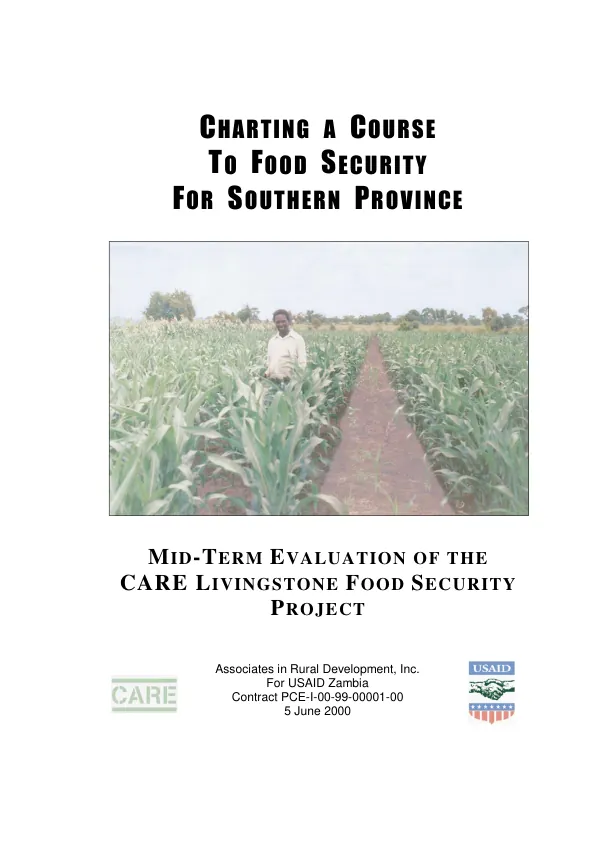
Charting a course to food security for Southern Province : mid-term evaluation of the CARE Livingstone food security project
Sign inASSOCIATES IN RURAL DEVELOPMENT, INC. (ARD)
Charting a course to food security for Southern Province : mid-term evaluation of the CARE Livingstone food security project
Evaluates Phase II of the Livingstone Food Security Project (LFSP), designed to improve food security and reduce vulnerability to drought in Livingstone, Zambia.
Lyons, Andrew; Johnson, Anthony · 2000
Sign in to readA free account is required to download.
Abstract
Mid-term evaluation covers the period 1996-6/00. The project is being implemented by CARE. LFSP has overall made significant progress in achieving three of its four objectives. (1) The development of community-based organizations (CBOs) provided the means to identify the underlying threats to food security and develop interventions that are demand- driven and relevant to beneficiary needs. The strong focus on CBO capacity-building has also proven to be an effective way to improve the delivery of services such as seed inputs and extension training, and has strengthened the ability of rural people to manage their own development activities and become less dependent on LFSP. The benefits of working together in small groups have been solidly demonstrated to both rural farmers and other institutions; this may very well be the most lasting legacy of LFSP. (2) The introduction of early maturing drought-resistant crop varieties may be the intervention that has most improved food security for the estimated 26,000 direct beneficiaries and their families. These improved varieties are bulked in a community-based seed multiplication scheme, ensuring sustained supplies of seed stocks. Although yield data are somewhat inconclusive, project monitoring data shows clearly that there is greater food availability in the communities than there was before the project started. (3) The improved farming practices are complemented by a program to improve water supply. Over 20,000 farmers and their families benefit from the 80 water- harvesting structures that have been built or rehabilitated with USAID financing. Although these structures have not made much impact on crop production, which remains largely rainfed, they have had a demonstrated positive impact on the health of people. Improved water supply has also benefitted the production of livestock and vegetables, which are sources of both food and income. (4) LFSP has been challenged to demonstrate significant impact in its last objective, income generation. The project has found it difficult to boost production of cash crops and other goods and services to a volume and level of efficiency high enough to compete in the market economy. It was also sidetracked on a savings and credit scheme that was based on an urban model and never achieved success in small-scale rural communities. However, the project has demonstrated on a limited scale a number of approaches for developing viable group enterprises, and the recent reorientation on strengthening market linkages bodes well for future progress. As the project nears the end of the current funding period, its major challenge is to begin to gradually move away from direct facilitation of activities and develop institutional partnerships or structures that will carry proven methods beyond the PACD. The strong focus on action research has made laudable strides in extracting lessons learned from technology demonstrations. However, LSFP has had much less success in building the bridges with private sector and government institutions that will be needed to sustain impact. The project acknowledges it must act in these areas, but may have to reexamine its current staffing skills and activity focus to prepare for the transition period. (Author abstract, modified)
Related documents
![Supporting sustainable and profitable agriculture : lessons learned from mid-term review of CLUSA/NRMP and WVIAP [Cooperative League of the USA/natural resources management project and World Vision integrated agro-forestry project] in Eastern Province, Zambia](https://covers.devme.ai/gen/5298.webp)