USAID. MISSION TO NEPAL
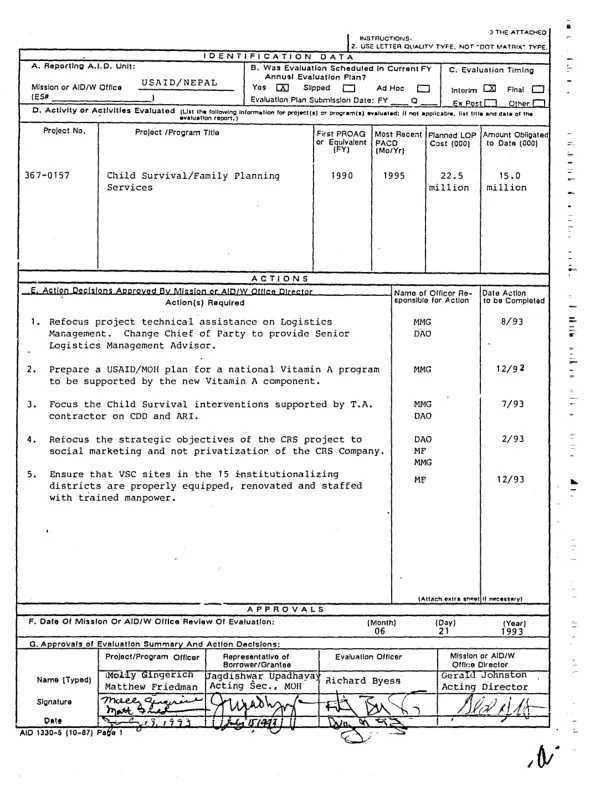
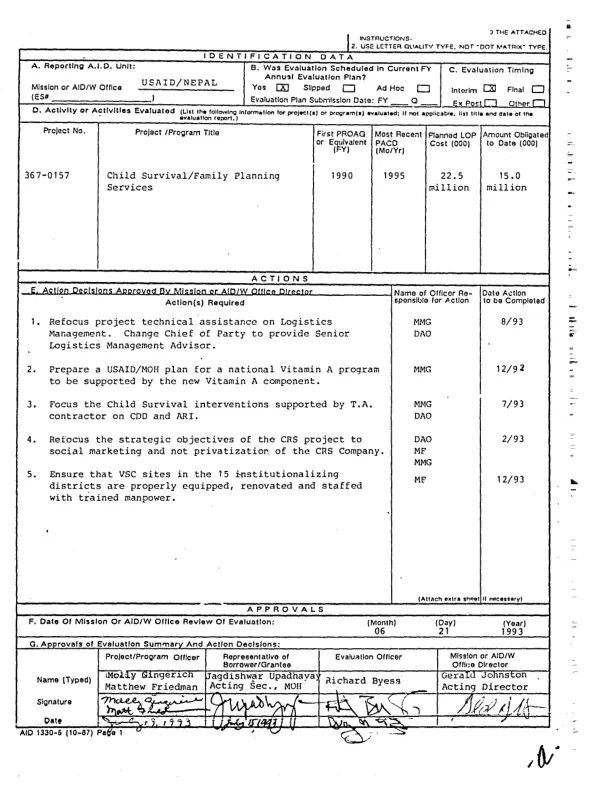
Child survival/family planning services
Summarizes interim evaluation of a project to help the Government of Nepal (GON) improve the quality and coverage of health care, family planning, and selected malaria control services, and improve management and organizational issues and practices affecting the delivery of those services.
1993
Sign in to readA free account is required to download.
Abstract
The project is implemented by eight American contractors, eight Nepali agencies, and departments/divisions of the Ministry of Health (MOH) at national, regional, and district levels. This midterm evaluation (6/90-2/93) was conducted by a team of external evaluators on the basis of a review of project documents, visits to District Public Health Offices (DPHO) in Bara, Chitwan, Kaski, Makwanpur, and Rupendehi districts, and interviews with USAID/N officials, MOH officials, other GON officials, representatives of other donor agencies, contractors, and DPHO officials. The purpose was to assess the progress to date, and to address a set of project- wide as well as component-specific issues and to provide feedback on implementation of the Child Survival/Family Planning Services Project (CS/FPS) to project managers and implementors. The major findings and conclusions are as follows. The CS/FPS has made considerable progress toward achieving its project goals and objectives and it should attain most objectives by 1995. Progress has been good in increasing the contraceptive prevalence by more than 20% in the project areas, training private sector physicians increasing sales of contraceptives, strengthening Maternal and Child Health (MCH) activities in four districts, conducting Control of Diarrheal Disease (CDD) training in eight districts, supporting the testing of implementation strategies for Acute Respiratory Infection (ARI) and vitamin A, supporting Female Community Health Volunteers (F/CHV) in 19 districts and training Passive Case Detection Volunteers (PCDVs) for malaria control in 50 districts. These achievements have been made in spite of the disruptions related to the recent elections in Nepal, reorganization of the MOH, and an incomplete staff complement in the Health and Family Planning office of USAID/N. The plans of MOH to reorganize itself in the near future will provide additional challenges to the project. In order to respond to the challenges, it is recommended that the focus of project activities shift from the regional to the national level, with district level implementation efforts focused on the 15 institutionalizing districts. Family planning services through private sector employers which are small and do not employ a large number of women would not bring wide-scale benefits. The evaluators noted the following lessons. (1) Family planning institutionalization needs to be undertaken in a phased approach insuring requirements are in place before discontinuing earlier approaches. (2) A project with as many disparate elements as this tends to diffuse the focus of the project from the project"s goal and purpose. Only those most closely associated with the project understand its intricacies, and it is difficult to convey what the project is about. Concentration on the most important technical and geographic areas for project emphasis should increase the probability of project impact. (Author abstract)