PROJECT CONCERN INTERNATIONAL (PCI)
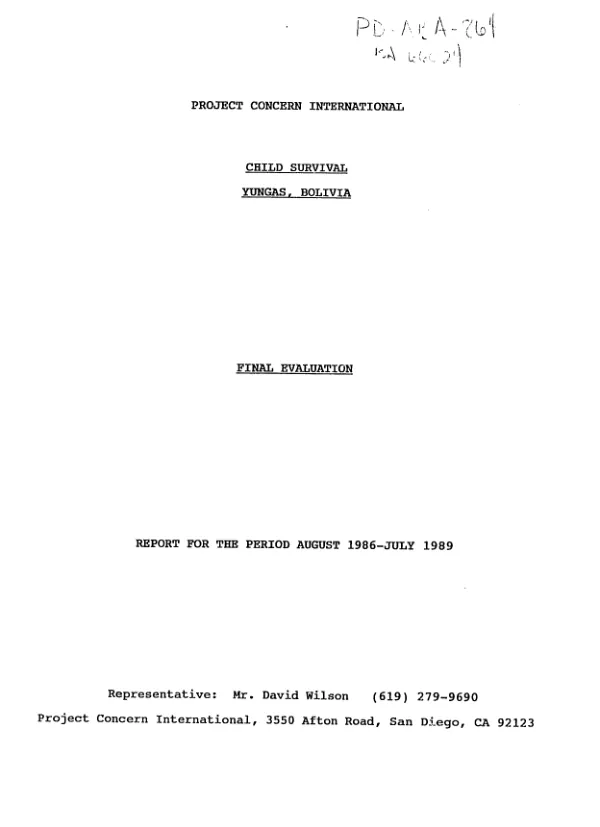
Child survival -- Yungas, Bolivia : final evaluation
Final evaluation of a project implemented by Project Concern International (PCI) to strengthen the capacity of the Chulamani Regional Office of Bolivia's Ministry of Health (MOH) to deliver child survival interventions in the Chulamani, Yanacachi, Coripata, and Irupano areas.
Sign in to readA free account is required to download.
Abstract
The evaluation covers the period 8/86-7/89. In general, the project achieved its goal of reducing the mortality and morbidity rates in children under five, while training targets were surpassed (and in some cases doubled), with a total of 1,308 community health workers (CHW's), rural auxiliary nurses, and community members trained in a variety of child survival areas. Growth monitoring/nutrition was one of the project's strongest components. The level of motivation was so high that CHW's purchased scales with their own money when the MOH could not supply them. In one site, growth charting reached 83% (the program attained an overall level of 55% in 1988), breastfeeding is in excess of 40%, and 70% of babies are weaned after the first year. However, the impact of nutrition education is limited, since the primary cause of malnutrition in the area is a lack of adequate quantity and quality of food. In other components, immunization coverage was very close to target; local people are now fully aware of the need to have their children vaccinated. Education in oral rehydration therapy, on the other hand, produced a very high level of theoretical knowledge, but actual use is limited because the community does not yet identify diarrhea as a potentially fatal disease. Efforts to control tuberculosis have been strikingly successful, due in good part to training of CHW's. Project impacts on acute respiratory infections are impossible to quantify, however. Continuation of project activities will be feasible only with external support for training and transport services. Future impact on malnutrition will also be dependent on improvements in local production capacity and establishment of a policy to sell produce only after local nutrition needs are met. Unfortunately, MOH policymakers do not tackle the problem of malnutrition at its root cause: insufficient availability of food. The MOH carries on with its health and prevention campaigns, when the most crucial problem to be addressed is the chronic hunger in the majority of the population in almost all the regions of Bolivia.
![Wawa sana [healthy child] : mobilizing communities and health services for community-based IMCI [integrated management of childhood illnesses] -- testing innovative approaches for rural Bolivia : Bolivia CS-16 -- final evaluation](https://covers.devme.ai/gen/5038.webp)