MACRO INTERNATIONAL INC.
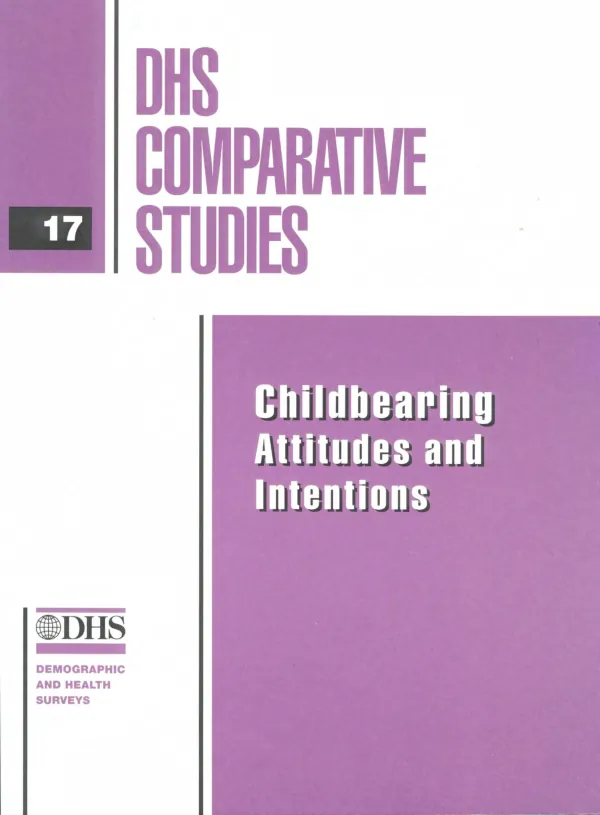
Childbearing attitudes and intentions
Based on national surveys in 28 developing countries, this study examines women"s statements on their ideal family size, whether they desire more children, and, if so, how long they would prefer to wait before the next birth.
Bankole, Akinrinola; Westoff, Charles F. · 1995
Sign in to readA free account is required to download.
Abstract
Levels of unwanted childbearing and the demographic implications of reproductive childbearing are also examined. The significance of this study for population policy and family planning programs is that it permits assessing the potential demographic impact of fertility regulation and indicates levels of unwanted fertility. The research reported here indicates that a preference for smaller families is spreading widely in developing countries. While the average number of children desired among ever-married women across 15 sub-Saharan African countries is 5.8, it is considerably lower in other regions of the world, ranging from approximately 2.5 to 4.0 children. Preferences for smaller families are typically stronger in cities than in rural areas, among women with some education, and for women who have been exposed to the mass media in general. The desire for smaller families is outpacing the decline of actual fertility. One result is that the level of unwanted childbearing is rising. An estimated 19% of women in the Asian, Latin American, and North African countries represented reported their last birth as unwanted, while 7% were in that category in the sub-Saharan countries. If women outside of sub-Saharan Africa had only the number of children that they wanted, their fertility rate would be 2.8 rather than 3.9. Within sub-Saharan Africa, the fertility rate would drop from an average of 6.0 to 5.1, a significant effect but still a very high level. In Bangladesh, which has had a comprehensive family planning program, the number of children desired has fallen to a level close to two; in neighboring Pakistan, an economically and culturally similar country without such a program and government support, the number desired has remained above four. This suggests that such programs with their extensive use of the media can generate demand as well as simply provide services. In general, there is a significant downward trend in the number of children desired over the past 10 to 15 years in all of the countries in which more than one survey has been conducted. In the great majority of countries, the proportion of women who say that they want no more children has increased by 10 to 15 percentage points. The length of preferred birth intervals was investigated with three different approaches which yielded a wide range of estimates from 2.5 to 4 years. The preferred birth interval has increased in length significantly in the countries included in both the earlier and later phases of the Demographic Health Survey. A majority of women outside of sub-Saharan Africa, except in Egypt and Pakistan, say that they have discussed the desired number of children with their husbands. Among countries in sub-Saharan Africa, there is a great deal of variation, with only 11% of women in Senegal saying they have discussed the number of children desired with their husband compared to 62% in Kenya. Compared to women in other regions, a high proportion of women in sub-Saharan Africa do not know the number of children their partners desires. When the husband"s view differs, almost invariably he is perceived to want more rather than fewer children than his wife. (Author abstract)
Related documents