PRAGMA CORP.
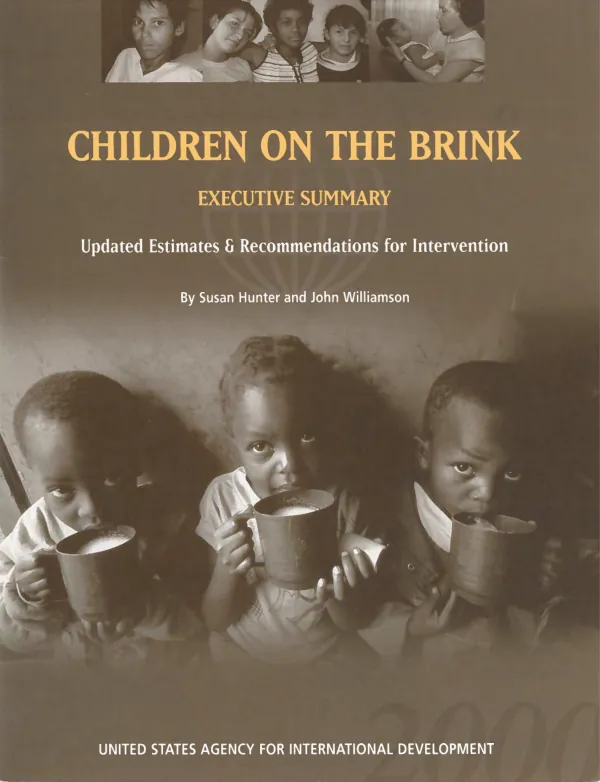
Children on the brink : strategies to support children isolated by HIV/AIDS
This report presents findings of a USAID- commissioned study by the U.S.
Hunter, Susan; Williamson, John · 1970
Sign in to readA free account is required to download.
Abstract
Census Bureau of the growing number of children orphaned as a result of the HIV/AIDS pandemic. The study includes estimates of maternal and double orphans caused by AIDS and by other causes in 23 countries heavily affected by AIDS, as well as complementary estimates of the population of paternal orphans, developed by using census data from developing countries and previous large- and small-scale studies of orphans. According to the report, 15.6 million children will have lost their mothers or both of their parents by 2000 in 23 countries heavily affected by HIV/AIDS. That number will increase to 22.9 million by 2010, largely as a result of the HIV/AIDS pandemic. When paternal orphans are included, the total number of orphans from all causes is projected to increase from 34.7 million in 2000 to 41.6 million in 2010 in these 23 countries. Of the 23 study countries, 19 are in sub-Saharan Africa, where by 2010 HIV/AIDS orphans will comprise up to 8.9% of children under age 15. At the same time, the sheer size of the population at risk for HIV/AIDS in Asia means that the problem of orphaning there will eventually eclipse that of sub- Saharan Africa. Also, the number of orphans will continue to grow in Latin America and the Caribbean, where the pandemic started later. The report also describes how the burden of increased orphaning is affecting individuals, families, and communities and what the response has been by those affected as well as by governments and aid organizations. Finally, the authors provide guidelines for assisting children, families, and communities affected by HIV/AIDS and outline six intervention strategies for governments, NGOs, and donors: (1) Strengthen the capacity of families to cope with their problems. (2) Stimulate and strengthen community-based responses. (3) Ensure that governments protect the most vulnerable children and provide essential services. (4) Build the capacities of children to support themselves. (5) Create an enabling environment for affected children and families. (6) Monitor the impact of HIV/AIDS on children and families.