WORLD RESOURCES INSTITUTE (WRI)
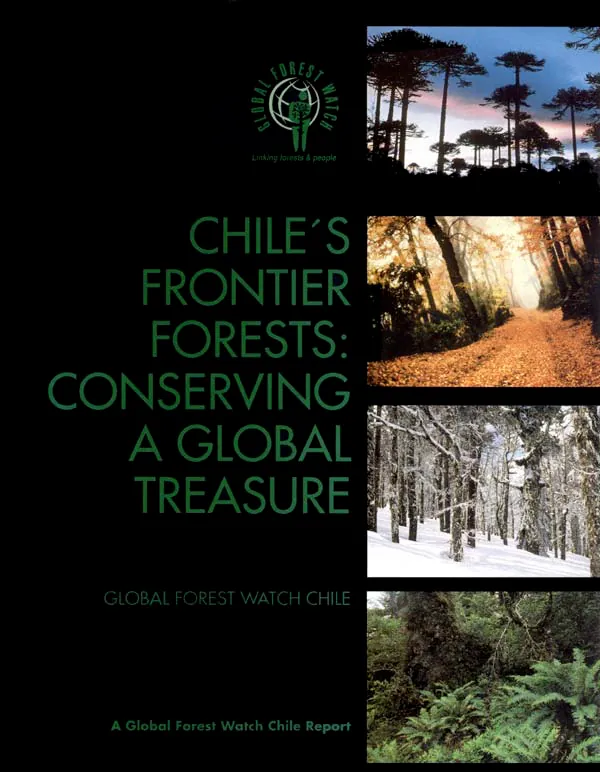
Chile"s frontier forests : conserving a global treasure
This report describes the state of Chile"s native forests, in particular (and for the first time) the extent and distribution of its frontier forests.
Neira, Eduardo; Verscheure, Hernan +1 more · 1970
Sign in to readA free account is required to download.
Abstract
These forests, which constitute a global reserve of biodiversity, are some of the most productive forests in the world, storing enormous amounts of carbon, which contributes to global climate regulation. The report also discusses the smaller patches of native forest (less than 5,000 hectares), which are important for maintaining biodiversity and other ecological processes and which serve as a genetic reservoir. Part one describes the importance of the Chilean forest, both locally and globally, while part two briefly describes the forest industry, its importance in the national economy, and existing legislation affecting forests. Regarding frontier forests, the report presents data concerning their extent, geographic distribution, state of conservation, and degree of representation in the public and private systems of protected areas. The report also provides information about industrial and development projects associated with forest ecosystems. All information is illustrated through maps. Results of the analysis show that, in Chile, frontier forests occupy 4.5 million hectares, or approximately 34% of all forested land. Approximately 27% of these frontier forests are in protected areas. At the regional level, the extent of frontier forests increases as one moves southward. Regions in which most of the development and industrial projects have occurred have fewer frontier forests left. For example, Regions VI and VII have lost all their frontier forests, and only fragments of slightly altered or undisturbed mature native forests remain. Region VIII, where most of the forestry plantations are concentrated, contains only 17,624 hectares of frontier forests, of which 80% are unprotected. Region IX has 154,527 hectares of frontier forest, but a large proportion (60.8%)is protected. In Region X, 26.6% of the large area of frontier forests (1,576,175 ha) is protected; however, the unique rainforests of the region"s Coastal Mountain Range are at high risk of fragmentation due to a planned coastal highway. After Region VIII, Region X has the greatest number of forestry plantations and industries in the country. Finally, Region XI and XII are the least disturbed regions, with 1,778,428.3 hectares and 946,930.5 hectares of frontier forest, respectively. In every region there is a strong inverse relationship between the presence of roads and industrial projects, on the one hand, and the extent of frontier forests on the other. A major conclusion is the need to produce and maintain a system of updated information that would not only register changes in forest cover over time, but also identify the root causes of these changes and the actors involved.