USAID. MISSION TO MOROCCO
Cidera school OPG
Presents final report (9/79-3/82) by OPG grantee, Catholic Relief Services, on a project to help CIDERA School, a Moroccan mid-level agricultural school, increase the economic efficiency and development potential of its model farm, demonstrate solar energy uses, and establish a health/nutrition rehabilitation center.
1970
Sign in to readA free account is required to download.
Abstract
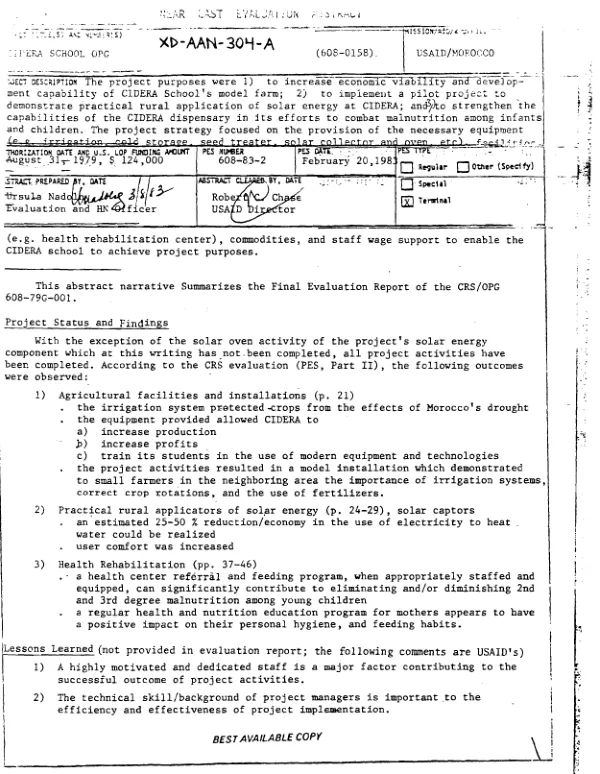
With the help of facilities acquired through the project, e.g., irrigation systems and a multi-ton cold storage facility, a strengthened CIDERA farm increased production of tangerines, corn, potatoes (virtually unplanted before the project), wheat and the straw from it, vegetable crops, milk, dairy cattle, and manure, helping the farm to realize substantial profits in 1980-1981. The project also made modern equipment and technology available for ongoing training of students in agriculture and farm management and helped provide a model showing farmers in the area the importance of irrigation systems, correct crop rotations, and the use of fertilizers, leading to visible increases in well-drilling efforts and intensive gardening. The Ministry of Agriculture and Agrarian Reform took over the farm in 1/81 and will pursue activities other than those pursued through the project. The Hassan II Institute of Agronomy and Veterinary Sciences, for example, will be allowed to use the farm for research and experiment purposes beginning in 4/82. Five solar captors were installed and reduced energy needs to heat water at CIDERA facilities by 25-50%, while increasing user comfort; five more are being installed. The solar oven component, begun in 9/80, has been somewhat delayed, but should be completed by 6/82 with the arrival of the remaining materials. Courses relating to the construction of solar energy equipment have been integrated into CIDERA"s curriculum. A child health rehabilitation center accomodating 14 children full-time and a dispensary serving 80-100 outpatients daily free of charge has been built and equipped. Screenings of child weight charts showed significant reductions in second and third degree malnutrition. Weekly courses for mothers in nutrition, hygiene, and natural family planning appear to have had a positive impact on their personal hygiene and feeding habits.