USAID DEC
CIP's Slide Training Series: True Potato Seed: An Alternative Method for Potato Production
Sign inUSAID DEC
CIP's Slide Training Series: True Potato Seed: An Alternative Method for Potato Production
The International Potato Center (CIP) has developed a training series to promote the use of true potato seed (TPS) as an alternative method for potato production in developing countries.
2010 · 14 pages
Sign in to readA free account is required to download.
Abstract
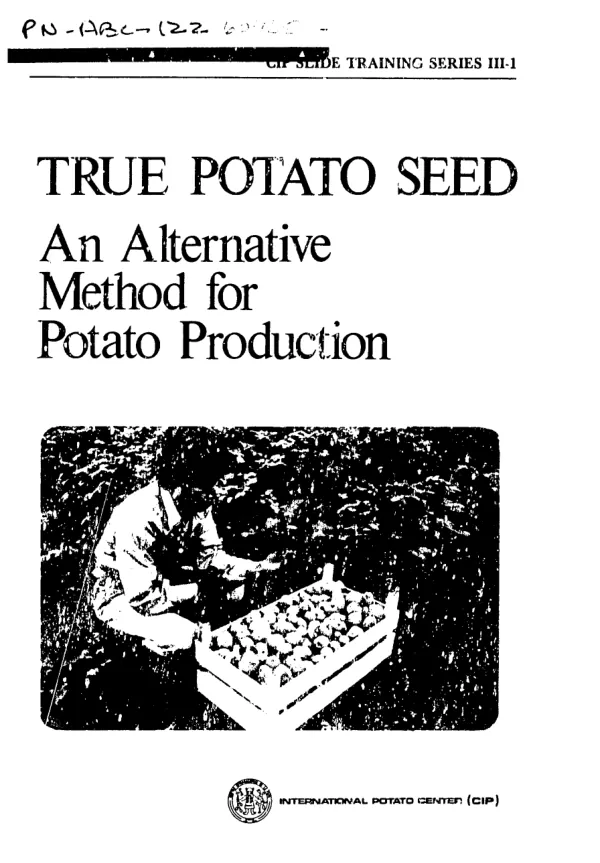
The first set in this series is entitled "True Potato Seed: An Alternative Method for Potato Production." This training series is designed to introduce individuals to the advantages of TPS over traditional potato tubers for potato production in developing countries. The main advantages of using TPS instead of seed tubers are: easy storage and transport, flexible planting time, new potato production areas, and low cost. TPS can be stored by farmers conveniently and inexpensively from one planting season to another or for several years. It is also easy and economical to transport. TPS can be easily introduced into existing farming systems because planting time does not depend upon the sprouting stage of seed tubers. Potato crops can be grown by field sowing, transplanting to field, or planting seed tubers produced from TPS. Field sowing has potential in areas with mild temperatures, where rainfall is light and evenly distributed during the first five to six weeks after sowing. This permits good germination and seedling establishment in the field. However, sowing directly to the furrow often produces inconsistent results. Transplanting TPS seedlings to the field has several advantages over direct sowing. First, plants are in the field less time, freeing the land for other uses. Weed competition is also reduced and agronomic practices are simplified. Furthermore, this method adapts better to the usual practices of Third World vegetable farming systems. TPS can be sown in trays or ground beds in a nursery. In warm climates, use of shade in nurseries for 15 to 20 days after sowing helps achieve more uniform emergence and vigorous seedling growth. Seedling emergence normally occurs between eight to ten days after sowing. Seedlings are thinned a week to ten days after emergence. Approximately 35 days after sowing, the seedlings are ready for transplanting. To reduce shock at transplanting due to adverse conditions, seedlings can be transplanted with soil-covered roots using containers such as compost cubes, banana leaf cups, or thin, plastic trays. The first generation of tubers produced from seedlings grown from TPS are referred to as "seedling tubers." This production method combines the advantages of TPS with those of planting seed tubers. Depending upon environmental conditions, seedling tubers will grow in densely sown ground beds or in rows in the field. When properly managed, a nursery bed will yield as many as 800 clean seedling tubers per square meter. Any successful true potato seed program must guarantee a reliable supply. Fortunately, TPS can be produced following steps similar to those used to produce many other vegetable crops. The production of TPS involves several stages, including seed selection, seed treatment, sowing, and harvesting. The quality of the TPS is critical to the success of the potato crop.